Concrete remains a foundational material in modern construction, valued for its strength, adaptability, and longevity across both residential and commercial settings. Yet even the most durable concrete eventually shows wear from heavy use, weather exposure, and environmental stress. When deterioration occurs, two key restoration methods, concrete resurfacing and concrete polishing, offer effective ways to renew function and visual appeal without full replacement.
Resurfacing applies a thin polymer-modified overlay that restores structure and aesthetics, while polishing mechanically grinds and refines the existing slab for a sleek, durable finish. According to the American Concrete Institute, resurfacing extends slab lifespan by 10--15 years, while polished concrete floors last over 20 years with minimal maintenance. In regions like New York, where freeze--thaw cycles and humidity pose challenges, these restoration systems deliver lasting performance, sustainability benefits, and measurable cost savings for long-term property value.
What Is the Difference Between Concrete Resurfacing and Concrete Polishing?
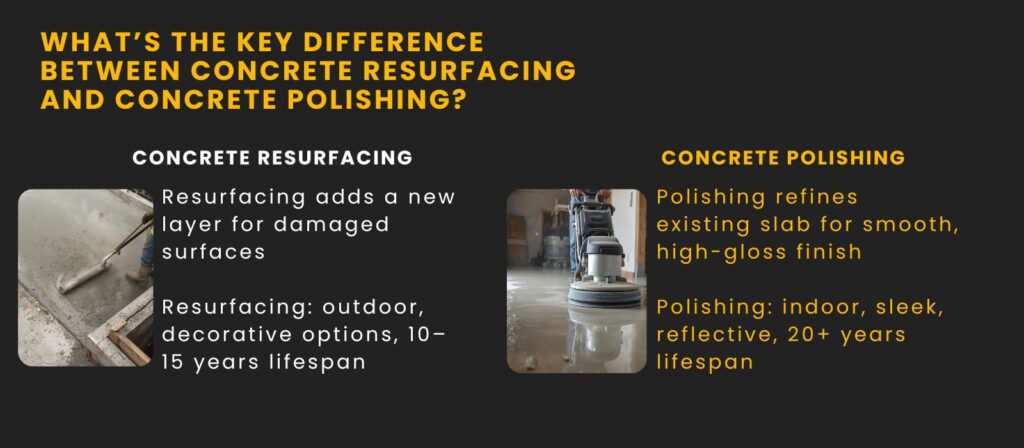
The difference between concrete resurfacing and concrete polishing lies in how each method restores or enhances a concrete surface. Concrete resurfacing adds a new polymer-modified overlay to repair cracks, hide damage, and create customizable textures or colors, making it suitable for visibly worn or structurally uneven slabs.
Concrete polishing mechanically grinds and refines the existing slab without adding new material, producing a smooth, glossy, low-maintenance finish ideal for surfaces that are already structurally sound.
What Is Concrete Resurfacing and How Does It Work?
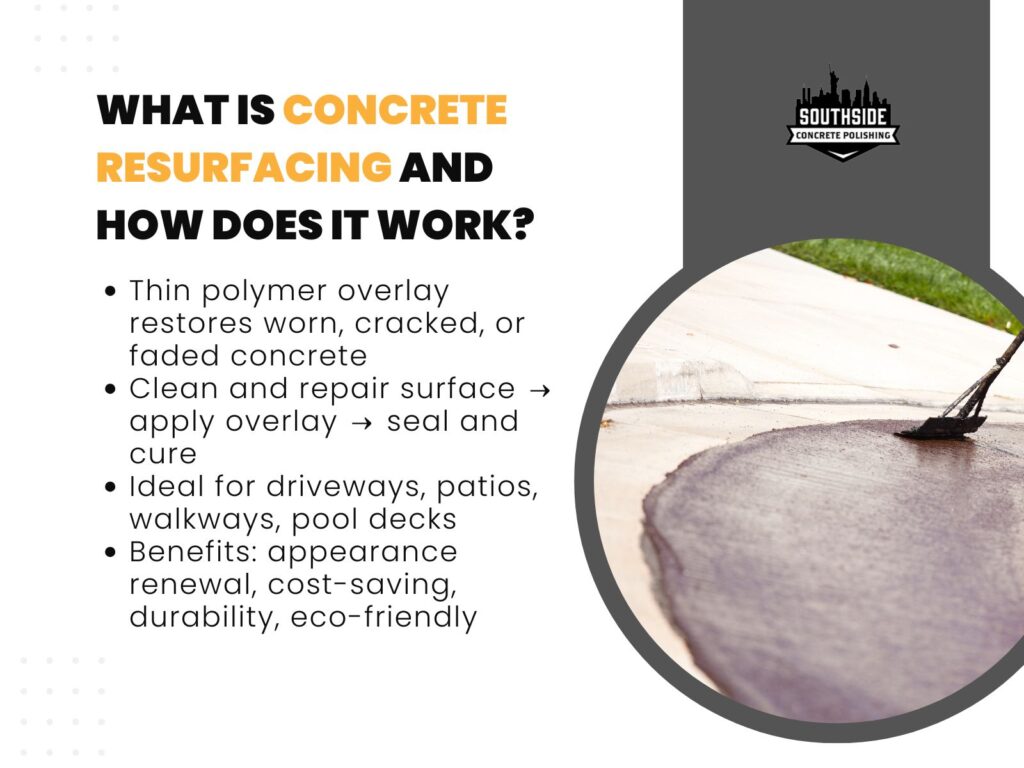
Concrete resurfacing is a restoration process that renews the surface of worn, cracked, or faded concrete without full replacement. It involves applying a thin polymer-modified overlay to the existing slab, which bonds chemically and mechanically to restore smoothness and aesthetics.
Resurfacing begins with cleaning and repairing the old surface. Cracks and holes are filled with an epoxy or polymer mixture, followed by mechanical preparation such as grinding or shot blasting. Once leveled, contractors spray or trowel a resurfacing compound across the area, sometimes integrating colorants, decorative textures, or stencils for design versatility. The final sealing and curing steps protect against moisture, UV rays, and future wear.
This technique is ideal for driveways, patios, pool decks, and commercial walkways where damage is primarily cosmetic. It offers a high return on investment by improving appearance and surface strength at a fraction of the cost of full slab replacement.
What Are the Benefits of Concrete Resurfacing?
The benefits of concrete resurfacing include improved appearance, cost savings, and extended surface performance. Concrete resurfacing merges form and function, providing a modernized look and longer lifespan for both residential and commercial settings.
The benefits of concrete resurfacing are as follows:
-
Aesthetic renewal: Resurfacing transforms dull or stained concrete into a clean, decorative finish with options such as stamping, staining, or micro-topping for stone or tile-like visuals.
-
Cost efficiency: It eliminates the need for demolition and new concrete pours, reducing labor and disposal costs by up to 50%.
-
Durability: Polymer-modified overlays increase resistance to moisture, chemicals, and abrasion.
-
Sustainability: By reusing the existing substrate, resurfacing minimizes material waste and reduces carbon emissions associated with concrete production.
What Is Concrete Polishing and How Is It Done?
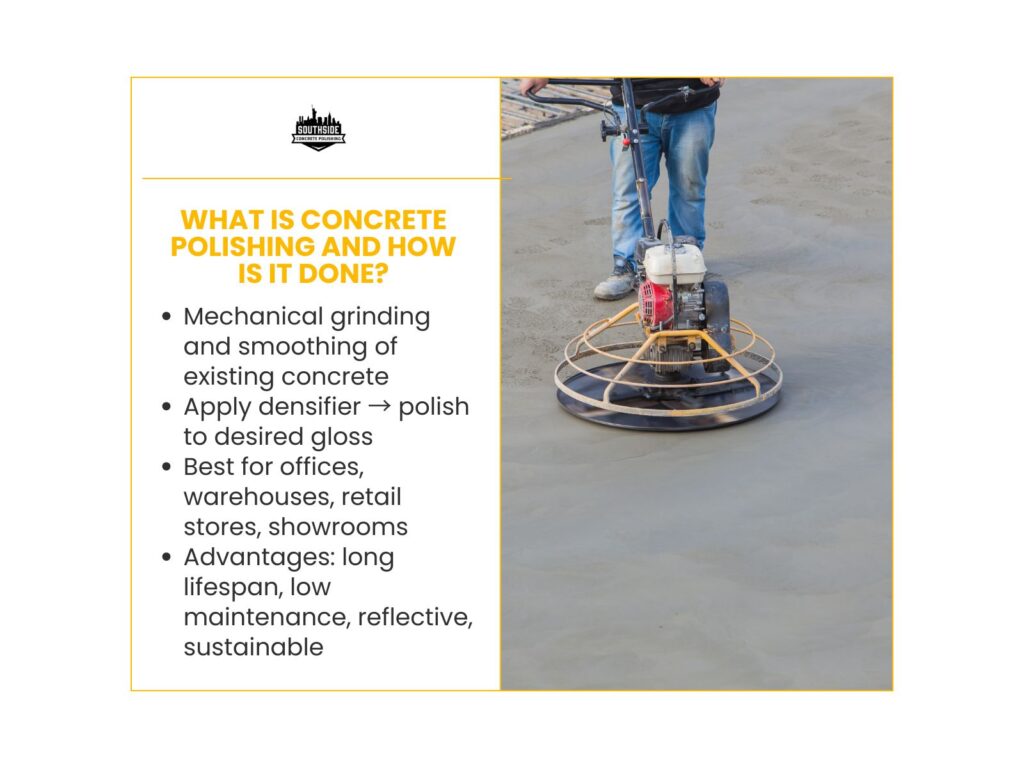
Concrete polishing is a mechanical refinement process that grinds and smooths existing concrete to create a glossy, durable surface. It does not involve overlays or coatings. Instead, diamond grinders incrementally refine the slab's surface to achieve a high-luster finish.
The process of concrete polishing includes multiple grinding stages, followed by the application of a chemical densifier that reacts with calcium hydroxide to harden the concrete matrix. The floor is then polished using progressively finer grits until the desired sheen, matte, satin, or mirror-like, is achieved.
Polished concrete floors are common in retail stores, offices, showrooms, and warehouses, where aesthetic clarity and low maintenance are priorities.
What Are the Advantages of Concrete Polishing?
The advantages of concrete polishing include improved appearance, long lifespan, and low maintenance. For property owners, polished concrete offers both durability and elegance, an investment that performs as well as it looks.
The advantages of concrete polishing are as follows:
-
Longevity: Professionally polished concrete floors last over two decades without major resurfacing. Their dense surface resists abrasion and impact, making them ideal for both residential and commercial spaces.
-
Low Maintenance: Polished concrete requires no waxing or sealants. Routine sweeping and occasional damp mopping keep the surface clean and glossy, reducing long-term maintenance costs.
-
Energy Efficiency: The naturally reflective finish enhances interior brightness by up to 30%, improving illumination and reducing reliance on artificial lighting.
-
Improved Indoor Air Quality: The nonporous surface prevents dust, mold, and allergen buildup while emitting minimal volatile organic compounds (VOCs), creating a healthier indoor environment.
-
Sustainability: Polishing reuses the existing concrete substrate, eliminating the need for additional flooring materials and minimizing construction waste. This supports eco-friendly building and renovation practices.
What Factors Help You Choose Between Concrete Resurfacing and Concrete Polishing?
The factors that help you choose between concrete resurfacing and concrete polishing include surface condition, functional needs, and aesthetic goals. Evaluating these parameters ensures that the selected method aligns with structural needs and design expectations.
The following factors help you choose between concrete resurfacing and concrete polishing:
-
Surface condition: If the slab has deep cracks, spalling, or unevenness, resurfacing provides structural correction. Polishing works best for surfaces with light wear or minor imperfections.
-
Function and traffic: High-traffic commercial zones benefit from polished concrete due to its hardness and reflectivity. Outdoor areas or heavily damaged surfaces perform better with resurfacing.
-
Design preference: Resurfacing offers customizable finishes, colors, textures, and stencils while polishing yields a sleek, uniform appearance.
-
Budget: Polishing costs $3--$12 per sq. ft., depending on gloss level, while resurfacing ranges from $4--$15 per sq. ft., influenced by design complexity and materials used.
What Are the Maintenance Requirements for Concrete Resurfacing?
Concrete resurfacing requires resealing every 2--3 years to maintain color depth and protect against moisture penetration. Routine cleaning with mild detergents and water helps prevent grime buildup.
Abrasive cleaners and deicing salts are avoided, as they erode the sealer and compromise surface integrity. Consistent care preserves the finish, prevents premature wear, and extends the overall service life of the surface.
What Are the Maintenance Requirements for Concrete Polishing?
Polished concrete is low maintenance, requiring regular dust mopping to remove debris and periodic cleaning with a neutral-pH solution to preserve surface clarity. When foot traffic dulls the sheen, mechanical re-polishing restores the original gloss without additional coatings. With consistent upkeep, polished concrete maintains its reflective appearance and durability for decades, offering one of the longest lifespans among flooring systems.
What Role Do Sustainability and Cost Efficiency Play in Concrete Restoration?
Sustainability and cost efficiency play a major role in concrete restoration by reducing environmental footprint and lifecycle expenses.
Both resurfacing and polishing reuse the existing slab, cutting down on waste and transportation emissions. Polished concrete contributes to LEED points through energy efficiency and low chemical use. Resurfacing achieves similar benefits by using recycled polymer compounds and water-based sealers.
From a financial standpoint, these methods offer high ROI. Polished floors reduce maintenance costs by up to 40% over their lifespan, while resurfaced floors extend usability by 10--15 years at half the replacement cost.
How Do Regional Considerations Affect Concrete Finishes in New York?
Regional considerations affecting concrete finishes in New York include freeze--thaw cycles, humidity, and deicing salt exposure common to the Northeast climate.
Contractors adapt by using air-entrained concrete and flexible polymer overlays that resist cracking from temperature fluctuations. Moisture barriers and UV-resistant sealers protect outdoor and basement installations from water damage. Slip-resistant textures are applied to sidewalks, pool decks, and entryways for safety in icy or rainy conditions.
By selecting materials engineered for local weather, New York property owners ensure their resurfaced or polished concrete surfaces remain stable, visually consistent, and long-lasting.
When Is Concrete Polishing the Right Choice for Your Property?
Concrete polishing is the right choice when your slab is structurally sound, generally even, and only shows light surface wear or dullness. It enhances the existing concrete without adding new material, delivering a sleek, reflective, low-maintenance finish ideal for commercial spaces like offices, showrooms, retail stores, and warehouses.
If you want long-term durability, improved light reflectivity, and a modern aesthetic with minimal upkeep,concrete polishing aligns best with these needs.
When Is Concrete Resurfacing the Right Solution for Your Property?
Concrete resurfacing is the appropriate method when the slab shows visible damage such as cracking, spalling, discoloration, or unevenness. It uses a polymer-modified overlay to rebuild the surface, allowing you to repair structural flaws while upgrading appearance through textures, colors, or decorative patterns. For outdoor areas, older slabs, and spaces needing both cosmetic and functional restoration, such as patios, driveways, and pool decks, concrete resurfacing provides a durable and visually renewed solution.