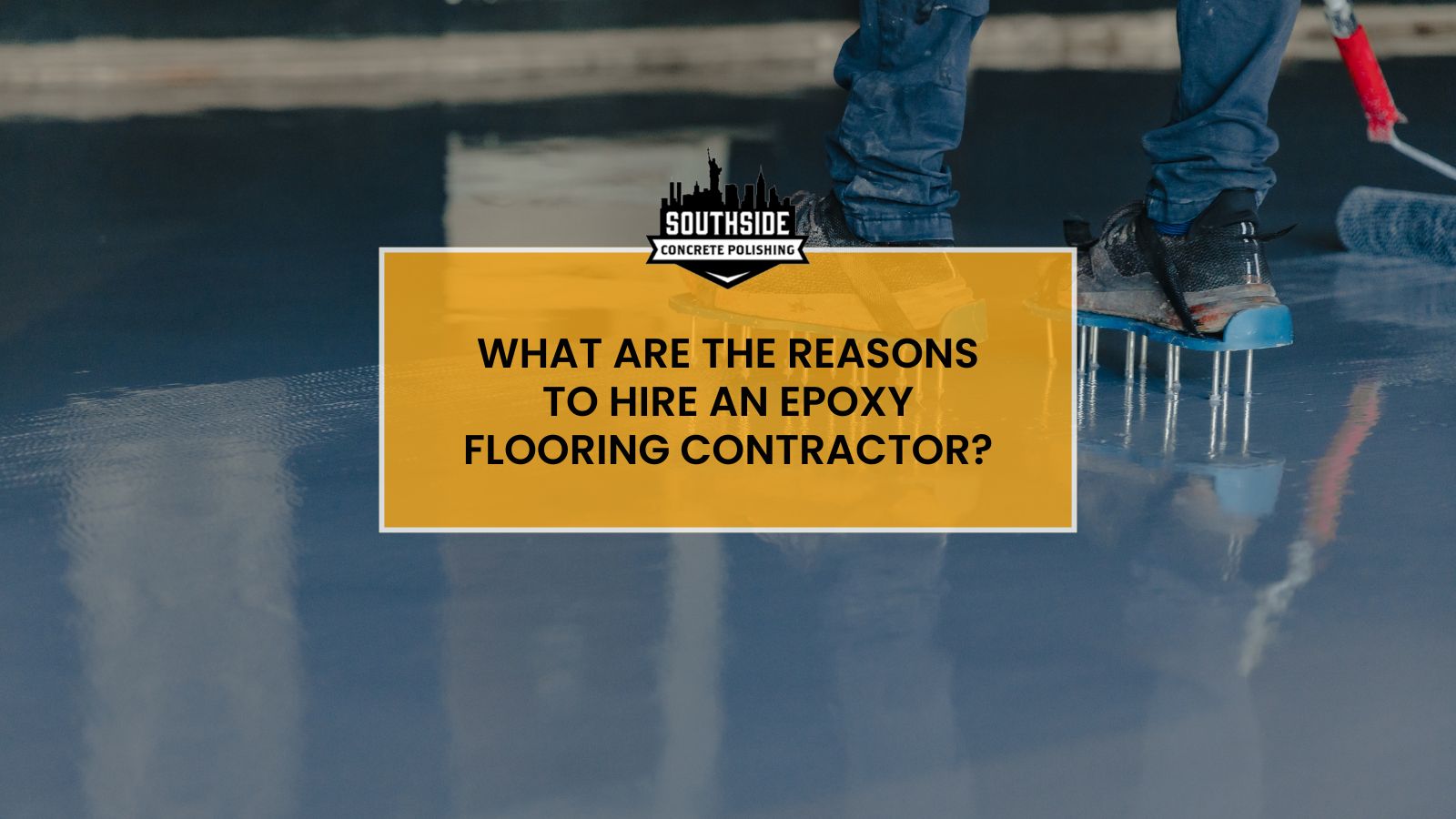
Hiring a professional epoxy flooring contractor ensures that every stage of installation, from surface preparation and material mixing to curing and environmental regulation, is executed with precision. Epoxy flooring is not just a coating but a chemical system requiring accurate resin-to-hardener ratios, controlled humidity, and specific curing conditions to achieve structural integrity and aesthetic quality.
Improper installation leads to peeling, bubbling, discoloration, and costly rework, while professional contractors guarantee long-term performance, safety, and compliance with industry standards. Professional contractors integrate quality testing, moisture control, and ASTM-verified methods to achieve coatings that withstand impact, abrasion, and chemical exposure.
According to data from the American Concrete Institute (ACI), professionally installed epoxy floors last up to 20 years, compared to 3--5 years for non-professional installations. This is a critical distinction in climate-variable regions, where freeze--thaw cycles and humidity affect curing dynamics. Properly installed systems thus deliver both immediate value and enduring performance.
Why Professional Installation of Epoxy Flooring Matters?
Professional installation of epoxy flooring matters because it ensures proper surface preparation, chemical mixing, and curing. Epoxy installation is not a simple coating application; it is a chemical engineering process. A professional contractor ensures that every layer from primer to topcoat bonds effectively to the substrate, maintaining both mechanical strength and aesthetic consistency.
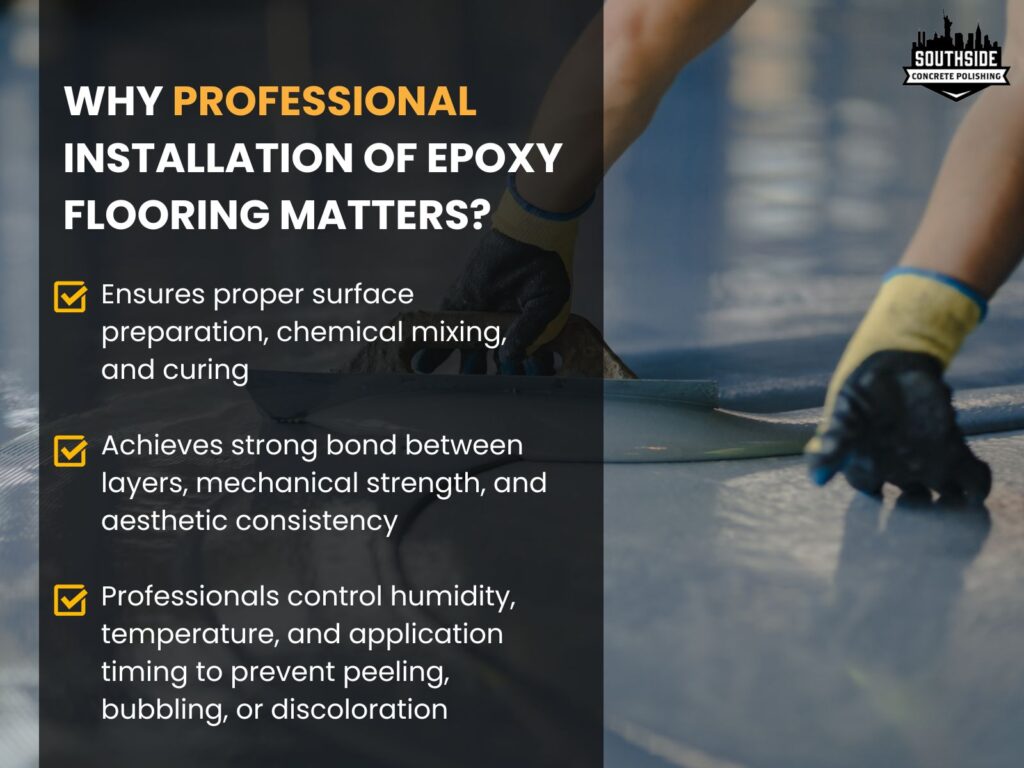
Professional installation of epoxy flooring matters because of the following reasons:
Accurate Material Mixing and Application Techniques
Proper mixing of epoxy resin and hardener is essential for correct polymerization. Professionals follow manufacturer-specified ratios and monitor the material's pot life to prevent premature setting or improper curing.
Professionals use calibrated mechanical mixers for consistency and apply the product using specialized tools like notched squeegees and rollers to ensure uniform coverage. Installers achieve a strong chemical bond between layers and eliminate defects such as air pockets or uneven finishes by applying each coat within the correct recoat window.
Comprehensive Surface Preparation and Profiling
Surface preparation accounts for most epoxy installation failures when done incorrectly. Professional installers remove oil, dust, laitance, and existing coatings through industrial grinding, shot blasting, or diamond tooling.
A professional achieves the correct Concrete Surface Profile (CSP), typically CSP 2--3 for most epoxy systems. They also perform moisture testing using calcium chloride or RH kits to confirm that the substrate is dry and stable. This ensures optimal adhesion and prevents issues like delamination, bubbling, or peeling over time.
Environmental Regulation During Installation
Epoxy curing is highly sensitive to environmental conditions such as temperature and humidity. Professionals maintain ideal parameters, generally between 60°F and 85°F with under 75% relative humidity, using dehumidifiers or heaters as needed.
Proper climate control prevents surface condensation, ensures even curing, and maintains consistent gloss and hardness. In regions with fluctuating climates, such as New Jersey, controlled installation conditions are vital for long-term flooring performance.
What Are the Common Problems Caused by Improper Installation of Epoxy Flooring?
The common problems caused by improper installation of epoxy flooring include peeling, bubbling, discoloration, and moisture blistering. These issues occur when the epoxy system is applied without proper surface preparation, environmental control, or adherence to mixing and curing protocols. Untrained installers underestimate the precision required in epoxy chemistry, leading to premature coating failure and costly repairs.
The common problems caused by improper installation of epoxy flooring are as follows:
Peeling and Delamination
Peeling occurs when epoxy is applied over a contaminated, unprofiled, or damp substrate. Without proper surface grinding or moisture testing, the resin cannot bond mechanically or chemically to the concrete. The result is weak adhesion, causing sections of the coating to lift or flake after curing.
Bubbling and Air Pockets
Bubbles or blisters form when trapped air expands beneath the coating during curing, often due to rapid temperature changes or improper roller techniques. Uncontrolled curing environments or overworked materials accelerate solvent release, creating voids.
Professional contractors maintain stable conditions and use spike rollers to vent air during application.
Discoloration and Uneven Finish
Improper pigment dispersion, surface contamination, or inconsistent curing temperatures lead to color variations and patchy finishes. Exposure to sunlight can also yellow non-UV-stable epoxies.
Experienced contractors avoid this by using UV-resistant topcoats and ensuring clean, uniform application across all sections.
Moisture Blistering
If epoxy seals a damp or vapor-emitting slab, trapped moisture builds pressure beneath the coating, forming blisters or fisheyes. Certified installers test for moisture using RH meters and apply moisture-tolerant primers or vapor barriers when required, ensuring long-term adhesion stability.
How Epoxy Flooring Contractors Ensure Long-Term Performance and Cost Efficiency?
Epoxy flooring contractors ensure long-term performance and cost efficiency by combining technical precision, material expertise, and lifecycle-oriented installation practices. At the same time, DIY epoxy kits seem budget-friendly, but improper mixing, curing, or surface preparation results in premature failure and expensive rework. Professional contractors prioritize performance, durability, and total lifecycle value rather than short-term savings.
Epoxy flooring contractors ensure long-term performance and cost efficiency in the following areas:
Durability and Structural Integrity
Certified contractors select industrial-grade epoxy formulations engineered to withstand heavy loads, thermal expansion, and chemical exposure. Properly installed epoxy coatings exhibit compressive strengths exceeding 10,000 psi, providing long-term resistance to impact, abrasion, and mechanical wear.
In industrial environments, such as manufacturing plants, warehouses, or food facilities, this durability minimizes downtime and floor repairs. In residential garages or basements, it prevents common issues like hot tire pickup, staining, and surface degradation.
Maintenance Reduction and Surface Longevity
A professionally applied epoxy floor forms a seamless, non-porous surface that repels dust, moisture, and spills. This minimizes the accumulation of bacteria and contaminants, making routine cleaning simple and cost-efficient. Most maintenance involves light sweeping and mopping with neutral detergents.
Over time, this low maintenance cost reduces operational costs in healthcare, retail, and commercial kitchens where cleanliness and hygiene are essential. Professional-grade topcoats also extend service life, delaying the need for reapplication or surface refinishing.
Enhanced Safety, Functionality, and Aesthetics
Epoxy flooring installed by professionals is customized with performance-enhancing features such as slip-resistant aggregates, anti-static coatings, and color-coded safety zones. These options improve worker safety and operational efficiency in commercial and industrial spaces.
Aesthetically, decorative epoxy finishes, including metallic, terrazzo, or quartz blends, provide a polished, professional appearance ideal for showrooms, offices, or public facilities without sacrificing durability.
Value Retention and Lifecycle Cost Efficiency
When installed to specification, epoxy flooring delivers exceptional return on investment through extended lifespan and reduced maintenance demands. According to American Concrete Institute (ACI) performance benchmarks, professionally installed epoxy floors lower lifecycle costs by up to 30% compared to traditional concrete resurfacing or tile systems.
The combination of mechanical strength, chemical resilience, and design adaptability adds long-term value to both residential and commercial properties.
What Expertise Should You Look For in a Professional Epoxy Contractor?
You should look for technical, material, and compliance expertise in a professional epoxy contractor. A qualified installer combines engineering precision with an understanding of surface science and environmental control. Their role extends beyond application; they manage every stage of the system's performance, from substrate evaluation to final inspection.
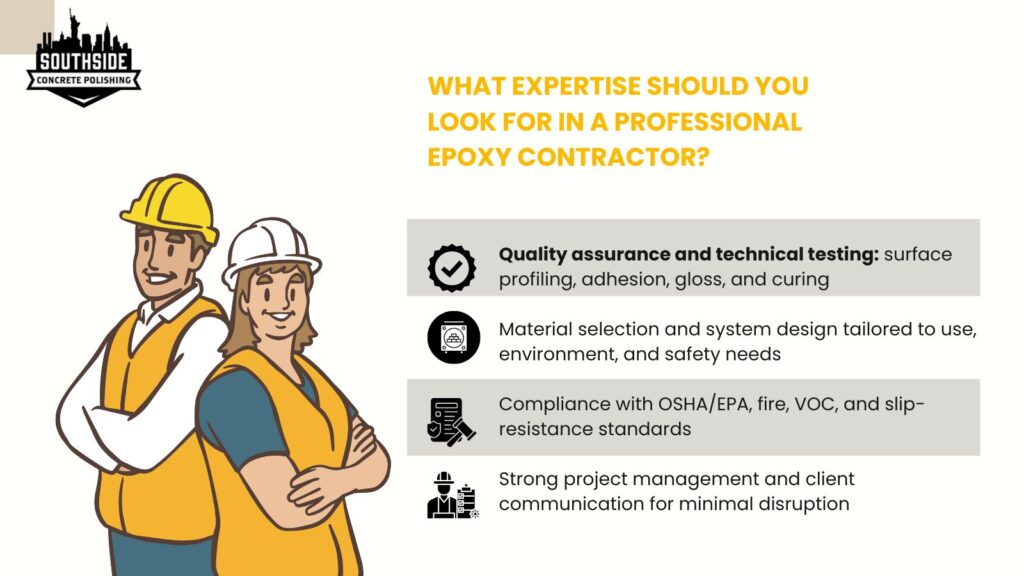
You should look for the following expertise in a professional epoxy contractor:
-
Quality Assurance and Technical Testing: A competent epoxy contractor performs objective quality control at each stage of installation. They test surface profile, bond strength, coating thickness, and curing hardness using instruments such as pull-off adhesion testers, moisture meters, and gloss meters. These assessments ensure that the floor meets ASTM D4541 standards for adhesion and ASTM D523 for gloss retention. Professional contractors document results and verify that coatings achieve specified performance metrics before project handover.
-
Material Selection and System Design: Epoxy systems are not one-size-fits-all. Skilled contractors analyze the intended use of the space and select formulations accordingly, solvent-free or low-VOC systems for food preparation areas, anti-static coatings for electronic facilities, or high chemical resistance for laboratories and manufacturing plants. They also design multi-layer systems, combining primers, base coats, and sealers for optimal adhesion, durability, and aesthetic finish. Correct material selection ensures the flooring system performs reliably under its specific mechanical and environmental stresses.
-
Compliance, Safety, and Environmental Standards: Certified contractors adhere to OSHA and EPA regulations for material handling, worker protection, and environmental safety. This includes maintaining adequate ventilation, using personal protective equipment, and ensuring the safe disposal of solvents and chemical residues. Compliance extends to fire resistance ratings, VOC emission limits, and slip-resistance standards under ANSI/NFSI guidelines. A contractor with updated safety certifications demonstrates both professionalism and accountability.
-
Project Management and Client Communication: Experienced contractors manage scheduling, environmental control, and coordination with other trades to prevent delays and cross-contamination. They provide transparent project timelines, detailed proposals, and maintenance guidance to ensure long-term flooring performance. Effective communication during the project minimizes operational disruption and ensures alignment with client expectations.
What Makes Epoxy Coated Concrete a Durable Flooring Choice?
Epoxy coated concrete provides a seamless, non-porous surface that strengthens existing concrete floors while enhancing visual appeal. Its chemical resistance, high compressive strength, and low-maintenance qualities make it ideal for both residential garages and high-traffic commercial areas.
Epoxy coatings extend the lifespan of concrete surfaces by filling minor cracks, protecting against moisture intrusion, and reducing dusting. These features of epoxy coated concrete improve safety, cleanliness, and light reflectivity, creating a more functional and aesthetically pleasing environment.
What factors influence the cost of epoxy flooring?
Epoxy flooring cost depends on factors such as floor condition, surface preparation, and coating thickness. The type of epoxy used, like metallic, flake, or self-leveling, is another driving factor to increase the cost of epoxy flooring. Labor costs and square footage also significantly affect the total price.
Is epoxy flooring a good long-term investment?
Yes, epoxy flooring offers excellent durability, chemical resistance, and low maintenance, often lasting 10--20 years with proper care. Its longevity and minimal upkeep make it a cost-effective choice for both residential and commercial settings.
Does epoxy flooring increase property value?
Yes, epoxy flooring increases the property value. Professionally installed epoxy floors enhance visual appeal, improve safety, and reduce maintenance costs, which increases the overall value and marketability of a property.