The best coating for your concrete surface depends on the balance between strength, flexibility, and environmental resistance required for your facility. Epoxy and polyurethane are the two leading options for commercial and industrial floors, each offering distinct advantages.
Epoxy flooring provides superior compressive strength exceeding 10,000 psi, making it ideal for warehouses, factories, and heavy-load areas. Polyurethane coatings, on the other hand, deliver exceptional UV stability, elasticity, and thermal shock resistance, performing reliably in temperature-variable or light-exposed environments.
As the U.S. industrial floor coatings market continues to expand at a 5.4% CAGR through 2030 (Grand View Research, 2024), choosing the correct system ensures long-term surface protection, reduced maintenance costs, and compliance with industry performance standards. Understanding how each coating responds to operational demands is essential to achieving durability, safety, and aesthetic consistency in high-performance concrete flooring applications.
What Are the Main Advantages of Epoxy Flooring?
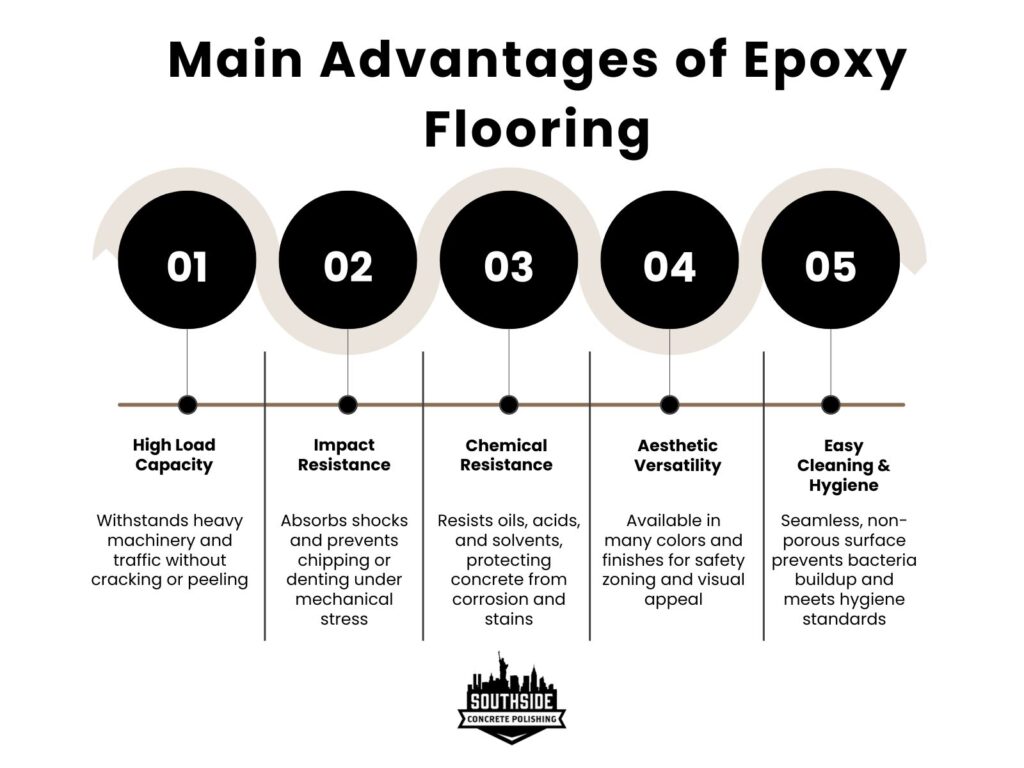
The main advantages of epoxy flooring include its exceptional mechanical strength, chemical resistance, aesthetic versatility, and ease of maintenance. This makes epoxy flooring one of the most durable and functional coating systems for industrial and commercial facilities. Epoxy flooring enhances both performance and appearance while reducing long-term maintenance costs, ensuring a reliable surface solution in high-demand environments such as warehouses, hospitals, and manufacturing plants.
Key advantages of epoxy flooring include:
-
High load capacity: Epoxy coatings withstand compressive stresses exceeding 10,000 psi, allowing them to support heavy machinery, forklifts, and constant vehicular movement without cracking or peeling. This structural strength makes epoxy a preferred choice in logistics centers, assembly lines, and heavy manufacturing areas where traditional concrete would degrade over time.
-
Impact resistance: The dense cross-linked polymer matrix of epoxy absorbs and disperses mechanical impact energy effectively. It prevents chipping, denting, or delamination caused by dropped tools, moving pallets, or machinery vibrations. This durability ensures long-lasting surface integrity even under daily industrial abuse.
-
Chemical durability: Epoxy flooring forms an impermeable, non-reactive surface that resists oils, fuels, solvents, acids, and cleaning agents. Its chemical resilience safeguards the concrete substrate from corrosion and staining, critical for automotive workshops, food processing plants, and pharmaceutical manufacturing areas that encounter regular chemical exposure.
-
Aesthetic flexibility: Available in a wide range of colors, textures, and finishes, including metallic, quartz, and flake systems, epoxy flooring enhances light reflectivity and visual appeal. Custom pigment blends allow for branding integration, safety zone demarcation, and improved visibility, creating both functional and visually cohesive workspaces.
-
Ease of cleaning and hygiene: Epoxy's seamless, joint-free surface eliminates grout lines and porous gaps where dirt, bacteria, and moisture typically accumulate. Its non-porous finish enables quick sanitation and compliance with FDA and USDA hygiene standards, making it ideal for healthcare, laboratory, and food-grade environments.
What Are the Key Benefits of Polyurethane Coatings for Concrete Floors?
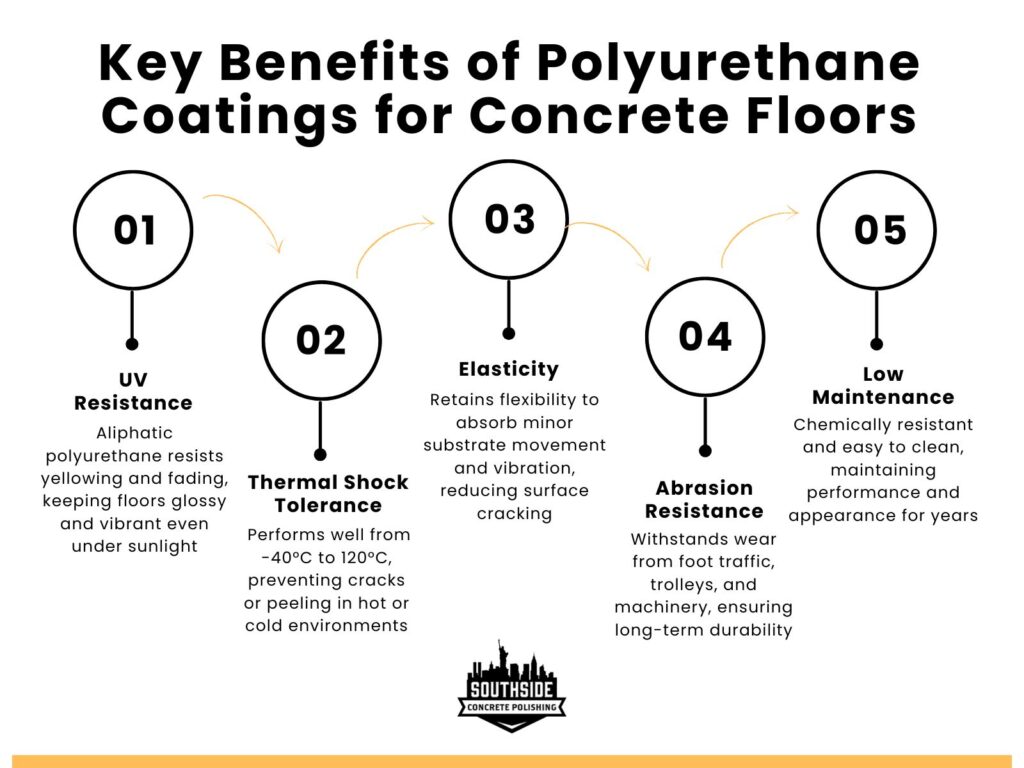
The key benefits of polyurethane coatings for concrete floors include their superior flexibility, UV stability, and resistance to thermal stress. The coatings make them ideal for facilities exposed to varying temperatures, heavy traffic, and demanding sanitation requirements. Unlike epoxy, polyurethane coatings maintain elasticity and color integrity even in high-movement or light-exposed environments.
Primary benefits of polyurethane coatings for concrete floors include:
-
UV resistance: Aliphatic polyurethane formulations maintain color stability and gloss under prolonged sunlight or UV exposure. This prevents yellowing, chalking, and fading, making them suitable for showrooms, airport terminals, and outdoor-connected facilities where aesthetic consistency is crucial.
-
Thermal shock tolerance: Polyurethane performs reliably across a wide temperature range, from -40°C to 120°C, without blistering or delamination. This thermal flexibility allows installation in environments such as commercial kitchens, cold storage units, and production plants that undergo frequent temperature fluctuations.
-
Elasticity and flexibility: Unlike rigid coatings, polyurethane retains a degree of flexibility after curing. It absorbs minor substrate movements and vibration, reducing the likelihood of surface cracking or stress fractures in large-span concrete slabs or structures exposed to thermal cycling.
-
Abrasion and wear resistance: Polyurethane's tough yet flexible surface resists scratches, scuffs, and surface erosion caused by high foot traffic, trolleys, or rolling equipment. This property ensures a longer-lasting finish in facilities such as malls, hospitals, and transportation hubs where daily wear is constant.
-
Minimal maintenance and longevity: With proper cleaning and periodic recoating every 7--10 years, polyurethane floors maintain their protective performance and aesthetic appeal. Their chemical and stain resistance minimizes downtime for maintenance, making them cost-effective for long-term facility management.
How Do Epoxy and Polyurethane Compare in Performance and Application?
Epoxy and polyurethane differ in mechanical behavior, environmental tolerance, and lifecycle cost, influencing their suitability for specific applications. Epoxy provides structural strength and cost efficiency for high-load zones, while polyurethane ensures flexibility and UV endurance for thermally or chemically active spaces.
The comparison between epoxy and polyurethane flooring is explained below:
Which Flooring Type Is More Cost-Effective Over Time?
Polyurethane flooring is more cost-effective over the long-term operation despite a higher upfront cost. A polyurethane system lasts 8 to 10 years, nearly twice the lifespan of a standard epoxy system, which averages 4 to 6 years under comparable load and exposure conditions.
The lifecycle advantage arises from polyurethane's superior wear resistance, elasticity, and lower maintenance needs. At the same time, epoxy installation costs 10--15% less initially, and the total cost of ownership favors polyurethane by reducing recoat frequency and downtime in continuous-operation facilities.
How Do Temperature and Humidity Affect the Installation of Epoxy and Polyurethane Flooring?
Temperature and humidity affect the installation of epoxy and polyurethane flooring by influencing the curing rate, adhesion strength, and final surface quality of the coating system. Environmental control is a critical factor during installation to ensure a seamless, defect-free, and durable floor finish. Professional applicators use hygrometers and infrared thermometers to ensure ASTM D1640-compliant curing conditions.
For the best results for epoxy and polyurethane flooring, follow the below-mentioned things:
-
Maintain ambient humidity below 70%.
-
Use dehumidifiers and temperature control for uniform curing.
-
Follow the manufacturer's pot-life and recoat window precisely to prevent delamination.
Can Epoxy and Polyurethane Be Combined for Optimal Results?
Yes, epoxy and polyurethane can be combined for optimal results. Combining epoxy and polyurethane creates a hybrid flooring system that integrates structural strength with surface flexibility. The typical configuration uses epoxy as the base coat for adhesion and build thickness, followed by a polyurethane topcoat for UV protection, chemical resistance, and gloss retention. Such dual-layer systems are widely adopted in manufacturing plants, parking decks, and laboratories, offering up to 15 years of service life under controlled maintenance.
This combination of epoxy and polyurethane provides:
-
Compressive strength from epoxy to stabilize the substrate.
-
Surface elasticity and UV protection from polyurethane to extend visual and functional longevity.
-
Reduced lifecycle cost through balanced performance and maintenance intervals.
Which Coating Is the Best for Your Concrete Surface?
Epoxy coating is best for your concrete surface if the facility operates heavy machinery, forklift traffic, or chemical processes that demand exceptional compressive strength and surface hardness. It delivers a dense, seamless layer that resists abrasion, impact, and industrial wear.
Polyurethane coating is best for your space if it experiences temperature fluctuations, sunlight exposure, or high pedestrian activity. The flexibility, UV resistance, and thermal shock tolerance of polyurethane help maintain long-term surface integrity.
A hybrid epoxy--polyurethane system offers the most balanced performance for environments needing both structural strength and environmental resilience. It combines epoxy's rigidity with polyurethane's elasticity, ensuring the floor remains durable, chemically stable, and visually consistent.
A professional evaluation of substrate moisture, ambient conditions, and traffic intensity confirms the ideal system that meets ASTM and ACI industrial flooring standards for longevity and safety.
Can self-leveling epoxy flooring be used with polyurethane topcoats?
Yes, self-leveling epoxy flooring can be combined with polyurethane topcoats to enhance performance and durability. The self-leveling epoxy acts as a structural base layer that fills surface irregularities, ensuring a smooth and level substrate with high compressive strength. Applying a polyurethane topcoat over the self-leveling epoxy provides added UV stability, scratch resistance, and long-term color retention. This hybrid configuration is ideal for warehouses, laboratories, and showrooms that require both mechanical strength and visual consistency.
What Are the Benefits of Epoxy Flooring for Commercial and Office Spaces?
The benefits of epoxy flooring for commercial and office spaces include superior durability, chemical resistance, and a seamless, easy-to-clean surface. Its high-gloss finish enhances light reflection, reduces maintenance costs, and improves workplace safety by minimizing dust and slip hazards. For businesses installing durable surfaces, epoxy flooring provides long-term structural strength and visual appeal.
How Can Metallic Epoxy Floors Improve the Appearance of Concrete Surfaces?
Metallic epoxy floors create a visually striking, three-dimensional effect that elevates the aesthetic appeal of standard concrete surfaces. They also provide a durable, chemical- and impact-resistant layer suitable for commercial, industrial, and decorative applications. The superior performance of metallic epoxy flooring ensures both protection and a high-end finish on concrete surfaces.