There are many options for garage floor coatings, and two of the most popular are epoxy and polyurea. Epoxy garage floor coating is a thermosetting polymer that is widely used as a coating for garage floors, while Polyurea garage floor coating is a durable, elastomeric coating formed through a chemical reaction. In markets like New Jersey, contractors report that demand for polyurea systems is growing rapidly because they handle the region's seasonal temperature variation and heavy commuter-garage traffic better.
Both bring distinct advantages that make them strong candidates for garage floors, but the right choice depends on usage, budget, and environment. Pick a coating that reliably handles the demands of vehicle loads, fluids, spills, temperature swings, and general wear if you're aiming for durability, ease of maintenance, and long-term value.
What is Polyurea Coating?
Polyurea coating is a newer polymer-based coating known for rapid curing and enhanced flexibility under stress. Polyurea coatings offer exceptional flexibility, chemical resistance, and rapid curing, making them ideal for high-traffic commercial spaces. With high tensile strength and elongation, they adapt to substrate movement while resisting heavy impacts, abrasion, and harsh chemicals. Their fast installation minimizes downtime, an advantage for operational facilities. Applied using specialized spray equipment, polyurea bonds tightly to various surfaces, delivering a durable, long-lasting protective layer widely used in automotive, construction, and industrial environments.
What is Epoxy Coating?
Epoxy coating is a resin-based two-part floor coating that cures into a rigid protective layer bonded to concrete. Epoxy coatings are created by combining a resin and hardener, forming a rigid, chemical-resistant surface ideal for demanding commercial environments. Epoxy systems are customized with additives to enhance adhesion, durability, or chemical resistance, meeting diverse facility requirements. They are known for their versatility. Epoxy delivers a strong, seamless finish widely used in construction, automotive, aerospace, and industrial settings for both performance and aesthetics.
What is the Difference Between Polyurea and Epoxy Garage Floor Coatings?
The difference between Polyurea and Epoxy garage floor coatings lies in their chemical composition, performance, and application characteristics. While both offer durable protection for commercial and industrial floors, they vary in flexibility, curing speed, resistance levels, and maintenance requirements. Understanding these differences helps property owners choose the most effective solution for their specific facility needs.
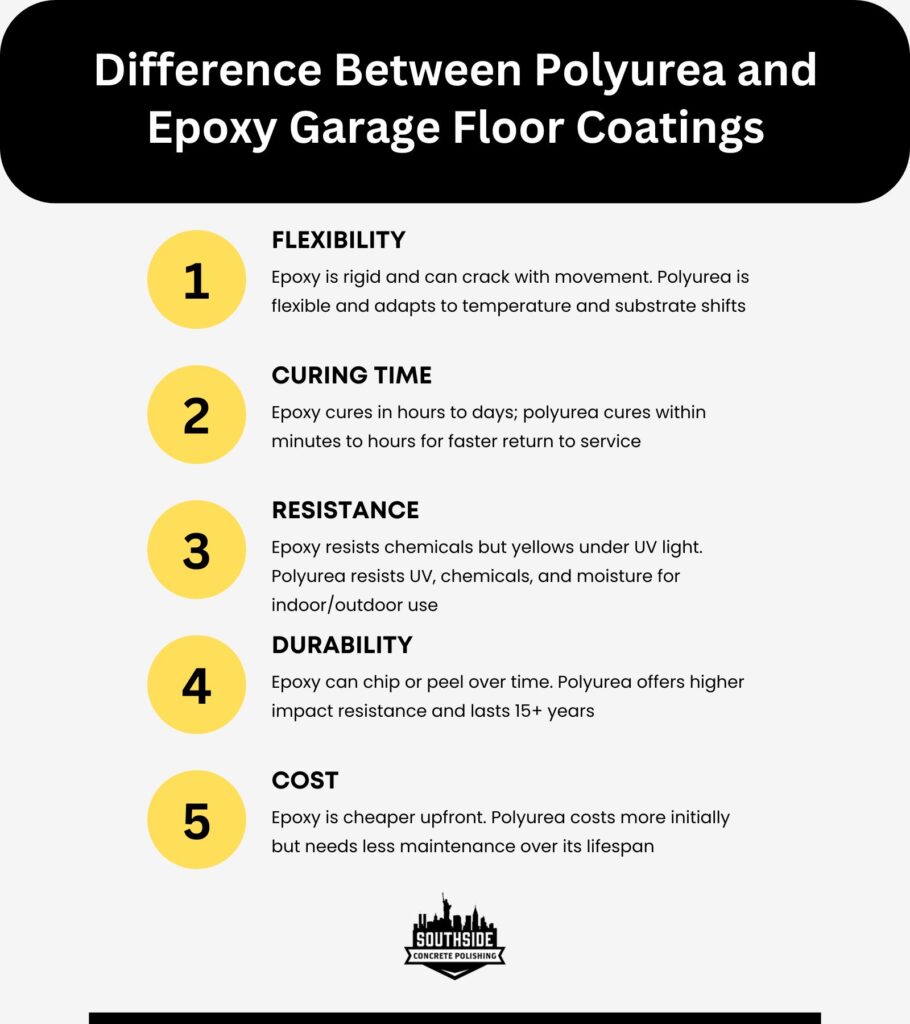
Here's a breakdown of the key differences between polyurea and epoxy coatings:
1. Composition and Flexibility
-
Epoxy is a resin-hardener system that cures into a rigid surface, offering high hardness but limited flexibility.
-
Polyurea, a newer polymer technology, is highly flexible and adapts to substrate movement without cracking, ideal for heavy-use or temperature-variable areas.
2. Curing Time
-
Epoxy takes several hours to days to cure completely, requiring longer downtime.
-
Polyurea cures within minutes to hours, allowing faster installation and quicker return to service, beneficial for commercial operations.
3. Chemical and UV Resistance
-
Epoxy is chemical-resistant but yellow or degrades under UV exposure.
-
Polyurea offers superior resistance to chemicals, UV rays, and moisture, making it suitable for both indoor and outdoor applications.
4. Durability and Longevity
-
Epoxy provides solid durability but chips or peels over time under extreme stress.
-
Polyurea delivers higher impact resistance and a longer lifespan (15+ years), even in high-traffic environments.
5. Cost and Maintenance
-
Epoxy is more budget-friendly upfront but needs recoating over time.
-
Polyurea has a higher initial cost but lower long-term maintenance, offering better lifecycle value for commercial floors.
What are the Factors To Consider When Choosing Between Polyurea and Epoxy Garage Floor Coatings?
The factors to consider when choosing between Polyurea and Epoxy Garage Floor Coatings include the nature of your facility, usage demands, environmental conditions, and budget. Both coatings deliver strong protection, but the best choice depends on how the floor performs under your specific commercial or industrial conditions. Evaluating these factors helps ensure the right balance of performance, durability, and cost-effectiveness.
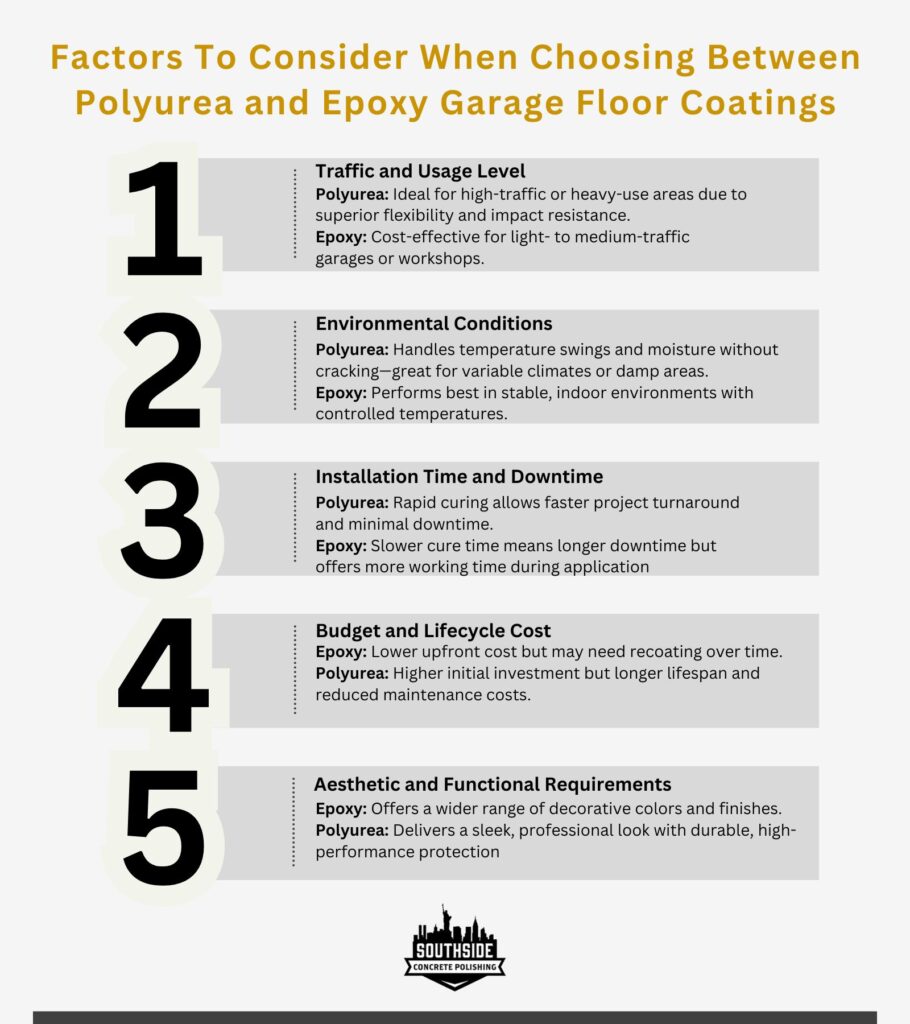
Here are the key factors to consider before making your choice:
1. Traffic and Usage Level
-
High-traffic commercial spaces, warehouses, or service areas benefit more from polyurea's flexibility and abrasion resistance.
-
For moderate traffic or light-duty garages, epoxy provides sufficient protection at a lower cost.
2. Environmental Conditions
-
Polyurea performs exceptionally well in environments with temperature fluctuations or moisture exposure, as it expands and contracts without cracking.
-
Epoxy is better suited for controlled indoor environments with stable temperatures.
3. Installation Time and Downtime
-
Polyurea cures rapidly, making it ideal for businesses that cannot afford long shutdowns.
-
Epoxy requires a longer curing process, extending downtime but allowing more working time during application.
4. Budget and Lifecycle Cost
-
Epoxy is more affordable upfront but needs reapplication after several years.
-
Polyurea is a higher initial investment but offers superior longevity and minimal maintenance, lowering lifetime costs.
5. Aesthetic and Functional Requirements
-
Epoxy provides more decorative finishes and color options.
-
Polyurea, while also customizable, is favored for its clean, high-performance finish suitable for professional and industrial aesthetics.
How to Choose Between Polyurea vs Epoxy Garage Floor Coating?
To choose between polyurea and epoxy garage floor coatings, you need to consider factors like durability, chemical resistance, installation requirements, budget, and the specific demands of your garage. Both coatings provide strong protection and aesthetic appeal, but their performance characteristics differ significantly. Understanding these differences ensures you select a coating that meets your long-term needs, whether for a residential or commercial garage.
Here's a detailed comparison of key factors to help guide your decision:
1. Durability
Both polyurea and epoxy provide a robust protective layer for garage floors, resisting impacts, heavy traffic, and abrasion. Polyurea excels in flexibility and elasticity, allowing it to handle concrete movement and temperature changes better, reducing the risk of cracks or delamination over time. Epoxy is durable but less forgiving under stress or substrate movement.
2. Chemical Resistance
Garage floors are exposed to oils, gasoline, and other chemicals. Polyurea offers superior chemical resistance, effectively repelling these substances and preventing staining or damage. Epoxy also resists chemicals but requires immediate cleaning after spills to maintain its surface integrity.
3. Installation and Curing Time
Polyurea coatings cure rapidly, within hours, minimizing downtime. A professional application is required with specialized spray equipment. Epoxy requires more curing time and multiple coats for optimal performance, extending the installation period.
4. Garage Floor Requirements
High-traffic areas, heavy vehicles, and machinery demand coatings that withstand wear, impacts, and chemical exposure. Polyurea is ideal for such conditions, while epoxy is suitable for moderate use but needs more frequent maintenance to preserve its protective properties.
5. Long-Term Performance
Polyurea's flexibility ensures long-term durability, accommodating expansion and contraction of concrete floors without cracking. Epoxy is strong but degrades over time under heavy stress or fluctuating conditions.
6. Cost and Maintenance
Epoxy is generally more budget-friendly upfront, though it requires periodic topcoat reapplication. Polyurea comes at a higher initial cost but offers superior longevity and minimal maintenance, making it cost-effective over the long term.
7. Customization Options
Both coatings are customized in color and finish. Epoxy, in particular, allows for glossy finishes and a wide variety of aesthetic options, while polyurea focuses on performance-oriented finishes suitable for commercial environments.
8. Professional Consultation
Before making a final decision, it's wise to consult with flooring professionals. They assess your garage's specific requirements and recommend a coating that balances durability, chemical resistance, aesthetics, and budget.
What are the Benefits of Polyurea and Epoxy Garage Floor Coatings?
The benefits of Polyurea and Epoxy garage floor coatings include enhanced durability, chemical resistance, aesthetic appeal, and long-term protection for your garage floors. Both coatings provide a strong, protective layer that withstands heavy traffic, spills, and daily wear, making them ideal for commercial and residential garages. Choosing the right coating ensures your garage floor remains functional and visually appealing for years.
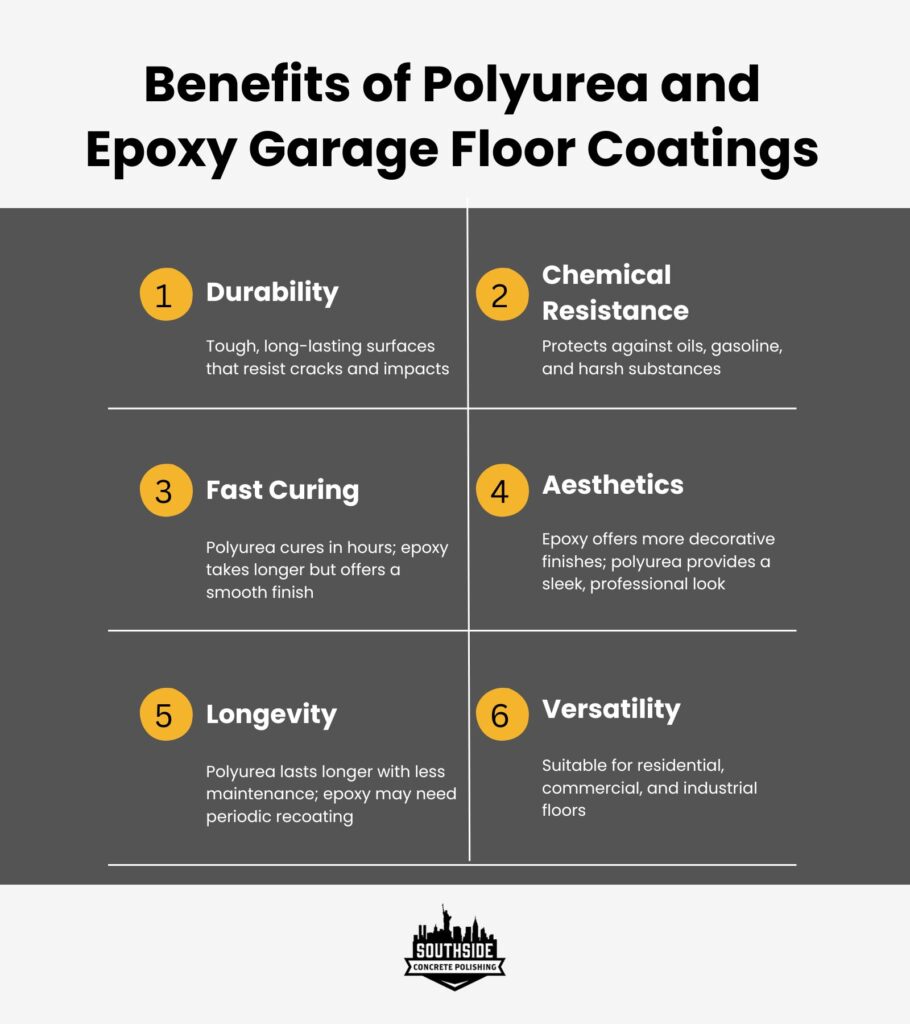
Here are the key benefits of polyurea and epoxy coatings:
-
Durability and Impact Resistance: Both coatings create a tough surface that resists cracks, chips, and wear. Polyurea excels in handling heavy traffic and impacts due to its flexibility, while epoxy offers strong, rigid protection suitable for moderate use.
-
Chemical Resistance: Polyurea provides exceptional protection against oils, gasoline, and industrial chemicals, preventing stains and damage. Epoxy also resists chemicals but requires prompt cleaning to avoid surface degradation.
-
Fast Installation and Curing (Polyurea): Polyurea cures quickly, within hours, reducing downtime in commercial or high-use garages. Epoxy takes longer to cure but allows for careful layering and a smooth finish.
-
Aesthetic Enhancement: Both coatings improve the visual appeal of garage floors. Epoxy offers glossy, decorative finishes and a variety of color options, while polyurea provides a clean, professional appearance suited for commercial spaces.
-
Longevity and Low Maintenance: Polyurea's elasticity ensures long-term performance with minimal upkeep. Epoxy is durable but needs periodic maintenance, such as reapplication of a topcoat, to sustain its protective properties.
-
Versatility Across Environments: Both coatings are applied in residential, commercial, and industrial settings. Polyurea performs well under temperature variations and heavy usage, while epoxy suits moderate environments with controlled conditions.
How long do polyurea coatings last?
Polyurea coatings last 15+ years with minimal maintenance. They are highly resistant to heavy traffic, impacts, and chemical spills, making them ideal for commercial and industrial garages. Additionally, their fast-curing nature ensures minimal downtime during installation, keeping operations running smoothly.
How long do Epoxy coatings last?
Epoxy coatings last 5--10 years, depending on usage and maintenance. Regular cleaning and occasional reapplication of a topcoat extend their lifespan and maintain a glossy appearance. While durable, epoxy flooring is more prone to chipping or staining under heavy traffic or chemical exposure compared to polyurea.
Is epoxy flooring a good alternative to polyurea for garage floors?
Yes, epoxy flooring is a good alternative to polyurea for garage floors due to its durability, chemical resistance, and aesthetic appeal. While polyurea offers faster curing and higher flexibility, epoxy flooring provides a strong, long-lasting surface suitable for both residential and commercial garages.
Do I need professional installation for Polyurea Vs Epoxy coatings?
Yes, you need professional installation for these coatings. Both polyurea and epoxy require professional application to ensure proper adhesion, curing, and long-term performance.
Are Polyurea Vs Epoxy coatings resistant to chemicals and spills?
Yes, these coatings are resistant to chemicals and pills. Polyurea provides superior protection against oil, gasoline, and industrial chemicals, making it ideal for commercial garages.
Can metallic epoxy flooring be used instead of standard epoxy for garages?
Yes, metallic epoxy flooring can be used instead of standard epoxy for garages. It offers the same durability and chemical resistance while adding a unique, reflective, and decorative finish. Metallic epoxy floor makes your garage floor visually striking, easier to maintain, and more resistant to stains and wear compared to traditional epoxy.
Is epoxy-coated concrete a good choice for garage floors?
Yes, epoxy-coated concrete is a good choice for garage floors because it provides a durable, chemical-resistant, and easy-to-clean surface. Epoxy-coated concrete protects the underlying concrete from stains, cracks, and wear while offering a sleek, professional finish that can last for years with minimal maintenance.