The best way to seal cracks in concrete is by using patching compounds, epoxy, or liquid fillers. These methods are chosen to match the width, depth, and condition of the crack. Proper cleaning, preparation, and sealing restore both the surface appearance and structural integrity of the concrete.
In New York's humid climate, data from the American Concrete Institute (ACI) shows that over 70% of concrete deterioration cases are caused by untreated microcracks, which expand over time due to freeze-thaw cycles, moisture intrusion, and load stress. Sealing cracks early prevents further expansion, corrosion of reinforcement steel, and costly structural damage.
Concrete is durable but not indestructible. Cracks appear due to thermal expansion, foundation movement, and environmental stress. Knowing how to correctly assess, clean, fill, and seal these cracks ensures long-term strength, safety, and aesthetics for any concrete surface, whether it is a driveway, patio, wall, or floor.
How To Seal Cracks in Concrete?
To seal cracks in concrete, start by identifying whether the crack is narrow or wide. Identifying the type of crack helps to choose the appropriate repair material, such as liquid crack filler for hairline gaps or patching compound for structural openings. The goal is to restore structural integrity, prevent water intrusion, and extend the lifespan of the concrete.
Sealing Wide Cracks in Concrete
Sealing wide cracks in concrete uses a patching compound or epoxy mortar designed for structural gaps larger than ¼ inch. The goal is to fill the entire depth of the crack and restore surface uniformity.
Follow these steps to seal wide cracks in concrete:
-
Clean and Undercut the Crack: Remove loose debris and chipped concrete using a hammer and chisel. Shape the crack into a "V" or inverted "U" profile to help the compound anchor more securely into the substrate.
-
Prepare the Patching Compound: Mix the compound exactly as per manufacturer instructions, maintaining the correct water-to-powder or resin-to-hardener ratio for optimal workability and bonding.
-
Apply the Compound: Use a mason's trowel to press the mixture firmly into the crack. Work the material deep into the void, stabbing slightly to expel trapped air pockets and ensure full contact.
-
Smooth and Level the Surface: Once filled, level the repair flush with the surrounding concrete using a finishing trowel. This creates a seamless transition across the repaired section.
-
Add Surface Texture (Optional): Lightly brush the surface while it's still tacky to mimic the original texture, ensuring visual consistency with the rest of the concrete slab.
-
Allow Proper Curing: Let the patch cure undisturbed for 24--48 hours or as specified on the product label. Temperature and humidity affect curing time, so follow environmental recommendations closely.
Sealing Narrow Cracks in Concrete
Sealing narrow cracks in concrete uses a liquid filler, caulking compound, or polyurethane-based sealer applied through a caulking gun or squeeze bottle.
Steps for sealing narrow cracks in concrete are as follows:
-
Clean and Dry the Area: Use a wire brush or pressure washer to remove dust, dirt, and debris from the crack. Allow the surface to dry completely to ensure proper adhesion of the filler.
-
Insert a Backer Rod (If Needed): For deep or through-cracks, insert a foam backer rod slightly wider than the crack. This limits filler depth and prevents excessive material use while ensuring flexibility.
-
Apply the Filler: Load a caulking gun or squeeze bottle with the chosen filler. Slowly dispense it along the crack, ensuring continuous coverage and penetration into the gap.
-
Smooth and Level the Surface: Use a putty knife or gloved finger to press the filler firmly into place and level it with the surrounding concrete for a seamless finish.
-
Allow Proper Curing: Follow manufacturer guidelines for curing time, typically ranging from several hours to a full day, depending on temperature and humidity.
-
Seal the Surface for Extra Protection: Once cured, apply a clear concrete sealer over the repaired area to improve resistance against moisture, oil, and chemical exposure.
What Causes Cracks in Concrete Structures?
Cracks in concrete occur because of internal and external stress factors that exceed the material's tensile capacity.
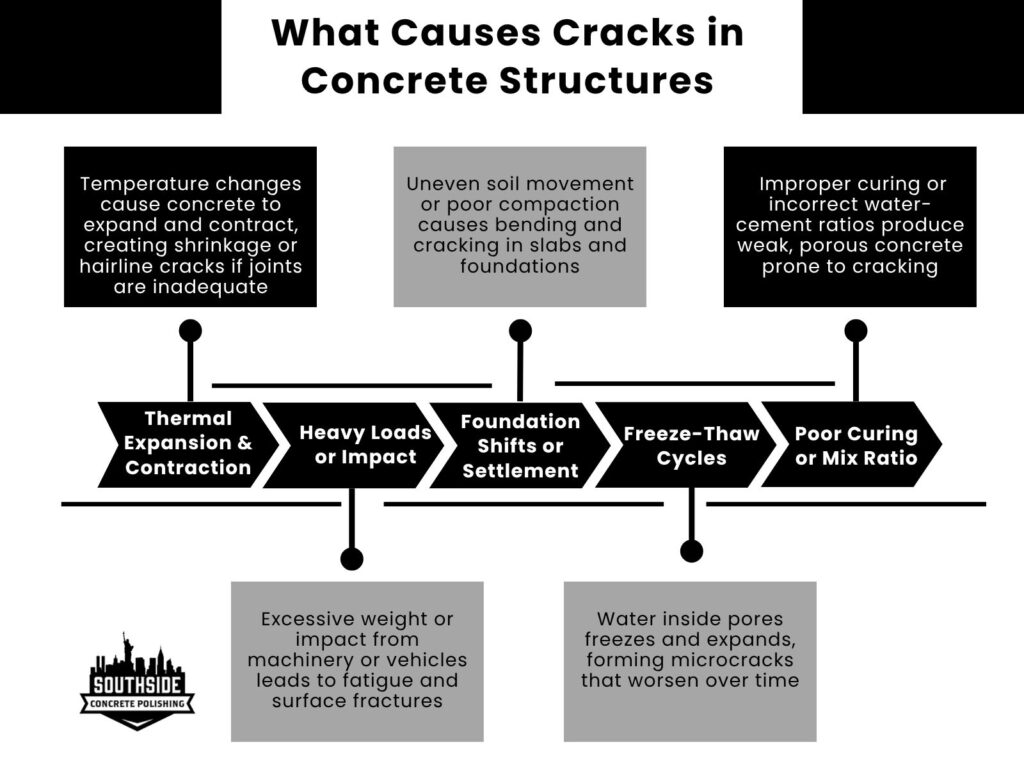
The most common causes of concrete cracks include:
-
Thermal expansion and contraction: Temperature fluctuations cause concrete to expand in heat and contract in cold conditions. Without adequate control joints or expansion gaps, this repeated movement creates internal stress that leads to shrinkage or hairline cracks. Over time, the cyclical thermal stress worsens, resulting in visible cracking and potential spalling.
-
Heavy loads or impact: Excessive loading from vehicles, equipment, or machinery exerts pressure beyond the concrete's design strength. Repeated mechanical stress weakens the surface layer, leading to fatigue cracking and localized surface failure. Impact forces, such as dropped tools or equipment, also create sharp fractures or chips that allow water penetration.
-
Foundation shifts or settlement: Uneven soil movement beneath slabs, caused by poor compaction, moisture changes, or subsidence, creates flexural stress. As the foundation settles, concrete bends and cracks at its weakest points. Structural reinforcement helps minimize damage, but differential settlement remains a leading cause of structural cracking in pavements and slabs.
-
Freeze-thaw cycles: In cold climates, water trapped within concrete pores freezes and expands, increasing internal pressure. When temperatures rise, the ice melts, leaving microcracks that gradually widen through repeated cycles. Without proper air entrainment or waterproof sealing, this process accelerates concrete deterioration.
-
Poor curing and mix ratio: Inadequate curing practices or incorrect water-cement ratios lead to weak, porous concrete. Rapid moisture loss during curing prevents full hydration of cement particles, creating a brittle structure that's prone to cracking under minimal stress. Similarly, an imbalanced mix with too little cement or excessive aggregates reduces cohesive strength and increases shrinkage potential.
What Tools and Materials Are Needed to Seal Concrete Cracks?
A set of cleaning, filling, and finishing tools designed for both surface and deep repairs is needed to seal cracks in concrete effectively. Each of these tools contributes to precision, adhesion, and durability while fixing the cracks in concrete.
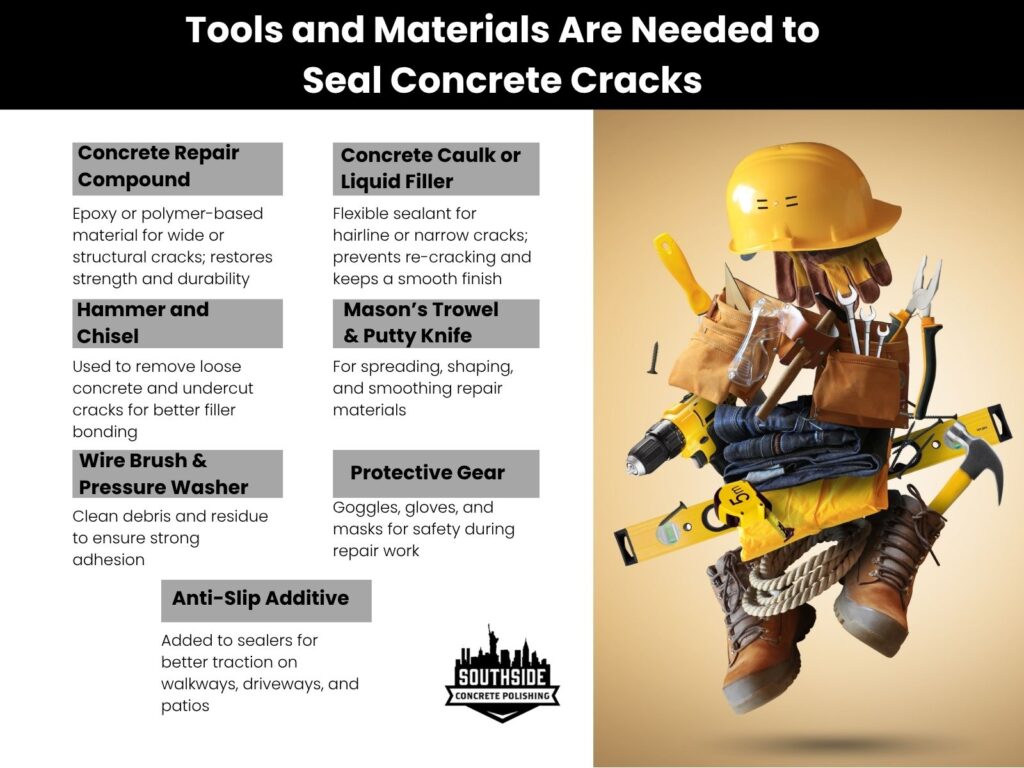
The essential tools and materials to seal concrete cracks include:
-
Concrete repair compound: Concrete repair compounds are used for wide or structural cracks. These compounds, typically epoxy- or polymer-based, create a dense, high-strength bond once cured. They are ideal for restoring load-bearing integrity in slabs, driveways, and structural concrete elements.
-
Concrete caulk or liquid filler: For hairline or narrow cracks under ¼ inch wide, flexible fillers or caulks are most effective. They expand and contract with temperature variations, preventing crack reformation while maintaining a smooth surface finish.
-
Hammer and chisel: A hammer and chisel are essential for removing loose material and widening the base of cracks to form an undercut. This step improves filler anchorage and ensures deeper penetration for lasting adhesion.
-
Mason's trowel and putty knife: These tools provide control and precision during application. A mason's trowel spreads larger repair compounds evenly, while a putty knife helps in detailing and smoothing smaller or narrow areas for a flush finish.
-
Wire brush and pressure washer: Surface cleanliness is key to effective bonding. A wire brush helps remove dust, efflorescence, and weakened concrete, while a pressure washer clears deep debris and residue, preparing the surface for filler or sealer adhesion.
-
Protective gear: Safety goggles, gloves, and dust masks are necessary during cleaning and repair to protect against airborne cement particles, caustic materials, and flying debris during chiseling.
-
Anti-slip additive: An anti-slip additive is mixed into final sealers to improve surface traction, especially important for patios, driveways, or walkways where moisture exposure increases the risk of slipping.
How To Prepare a Concrete Crack Before Sealing?
To prepare a concrete crack before sealing, start by cleaning, widening (if necessary), and drying the area to guarantee maximum adhesion. Surface preparation determines how well the filler bonds and cures.
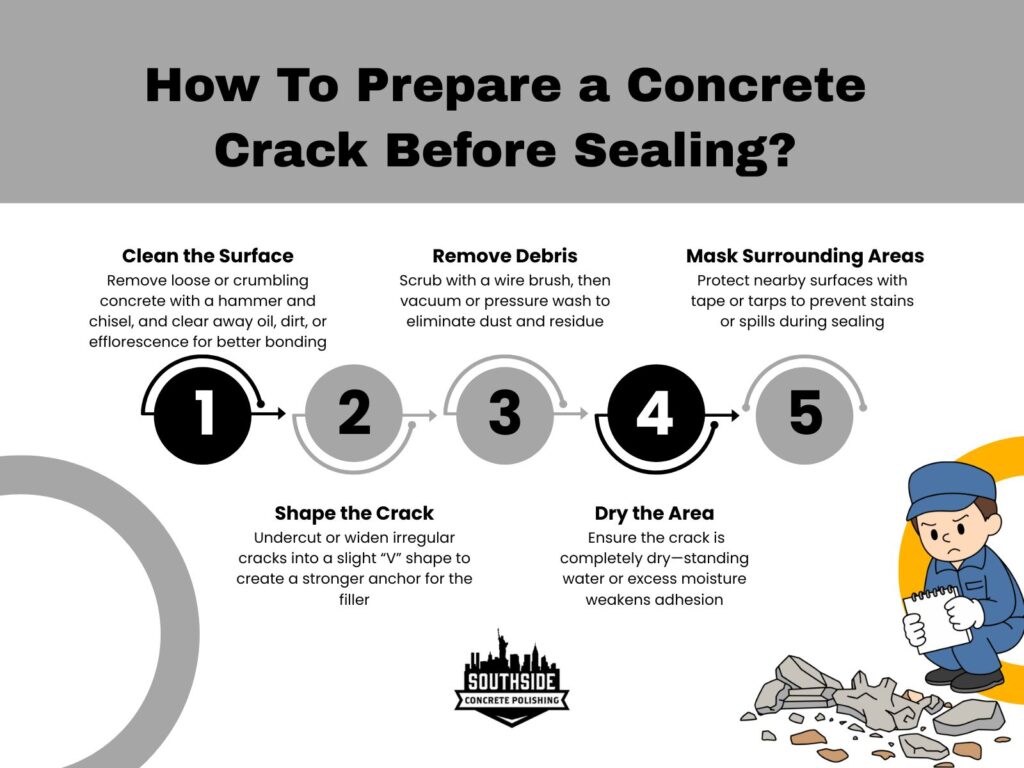
Use the following steps to prepare a concrete crack before sealing:
-
Clean the surface: Begin by removing all loose or crumbling material using a hammer and chisel. This step exposes solid concrete beneath the damaged layer, allowing the sealing compound to grip more effectively. Cleaning also eliminates contaminants like oil, dirt, and efflorescence that weaken bonding strength.
-
Shape the crack: For larger or irregular cracks, use a chisel to undercut the edges into a slight "V" shape. This mechanical design widens the base of the crack, creating a stronger anchor point for patching material and preventing the sealant from lifting over time.
-
Remove debris: After shaping, scrub the inside of the crack with a wire brush to dislodge fine dust, then use a vacuum or pressure washer to clear away remaining particles. Removing all debris ensures no obstruction between the filler and the concrete surface, improving both penetration and curing consistency.
-
Dry the area: Moisture trapped inside a crack compromises adhesion. Allow the surface to dry completely before applying the filler. While some patching compounds tolerate mild dampness, standing water should always be eliminated to avoid curing defects.
-
Mask or cover surrounding areas: Use painter's tape or a tarp to cover adjacent surfaces. This prevents accidental spills or residue from staining finished concrete, especially on decorative or polished floors.
What Are the Best Products for Sealing Cracks in Concrete?
The best products for sealing cracks in concrete include epoxy compound, latex or polymer-modified patching compound, and hydraulic cement. The choice of the sealing product depends on the width, depth, and exposure of the damaged area. Choosing the right sealant ensures both mechanical strength and weather resistance.
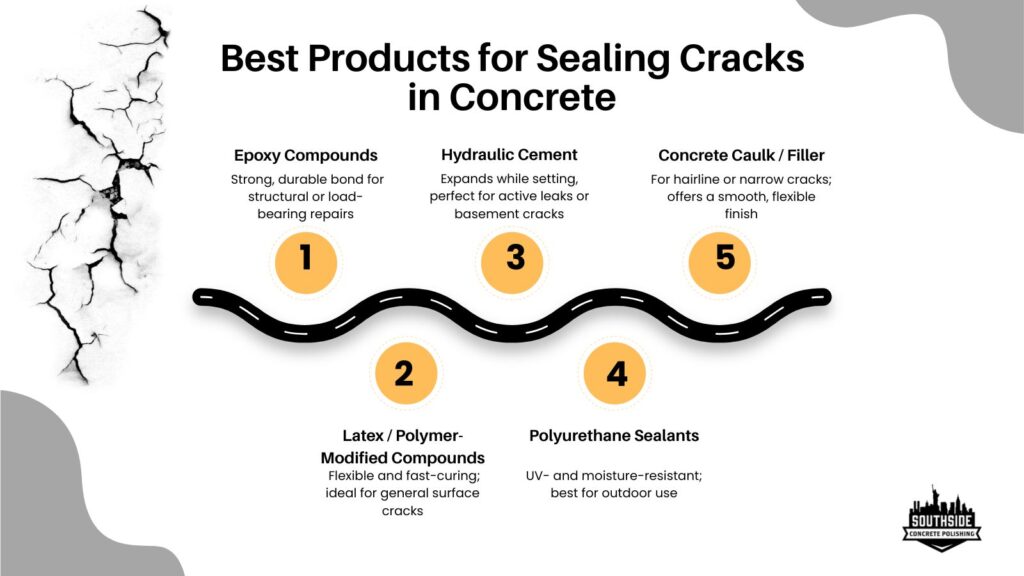
Common types of concrete crack sealers include:
-
Epoxy compounds: Best for structural repairs. They bond tightly and restore load-bearing capacity.
-
Latex or polymer-modified patching compounds: Suitable for general surface cracks; flexible and quick to cure.
-
Hydraulic cement: Expands as it sets, making it effective for active water leaks and basement cracks.
-
Polyurethane-based sealants: Ideal for outdoor applications due to UV and moisture resistance.
-
Concrete caulk or filler: Used for hairline or narrow cracks, providing a clean and flexible finish.
Why Is Applying a Concrete Sealer Important After Crack Repair?
Applying a concrete sealer after crack repair is essential because it creates a continuous protective layer that prevents moisture, oil, and chemicals from penetrating the surface. It also enhances the overall durability and visual uniformity of the repaired area.
Use a penetrating sealer for natural concrete finishes or a film-forming sealer for glossy protection. Two coats of concrete sealers are recommended for maximum performance. Adding an anti-slip additive improves traction on smooth surfaces such as garage floors or patios.
A well-sealed surface minimizes future cracking, repels stains, and makes routine maintenance easier.
Can Epoxy Floor Coating Be Used to Seal and Protect Concrete After Crack Repair?
Yes, epoxy coating can be applied over repaired concrete surfaces to create a durable, chemical-resistant, and seamless finish. Once cracks are sealed and cured, an epoxy floor coating strengthens the surface, prevents moisture penetration, and enhances aesthetic appeal. Epoxy floor coating is especially effective for garages, warehouses, and industrial floors where long-term protection and easy maintenance are priorities.
Is Polished Concrete a Cost-Effective Option After Sealing Cracks?
Yes, polished concrete remains a cost-effective option after sealing cracks because the polishing process restores a smooth, uniform surface while increasing the floor's strength and shine. It also enhances durability, reduces long-term maintenance needs, and delivers a clean, high-performance finish suitable for residential, retail, and commercial spaces. This makes it an excellent choice for anyone seeking cost effective concrete polishing.