The process of restoring damaged concrete floors, sidewalks, and walkways involves advanced resurfacing methods such as self-leveling epoxy and concrete overlays. These techniques combine durability, functionality, and aesthetics. Fixing concrete floors and sidewalks corrects surface defects, seals cracks, and enhances load-bearing strength while improving visual uniformity and resistance to wear.
In New Jersey, where fluctuating temperatures and de-icing chemicals accelerate concrete deterioration, nearly 60% of commercial and municipal properties require some form of concrete resurfacing every 8--10 years, according to regional maintenance studies. Self-leveling epoxy offers a seamless, low-maintenance finish suitable for both industrial and residential applications, while concrete overlays reinforce structure in high-traffic zones like warehouses, sidewalks, and car parks.
Together with polished concrete systems, these methods extend surface lifespan, improve safety, and reduce long-term repair costs, making them practical, high-performance solutions for maintaining concrete infrastructure in demanding climates.
How Can Damaged Concrete Floors, Sidewalks, and Walkways Be Repaired?
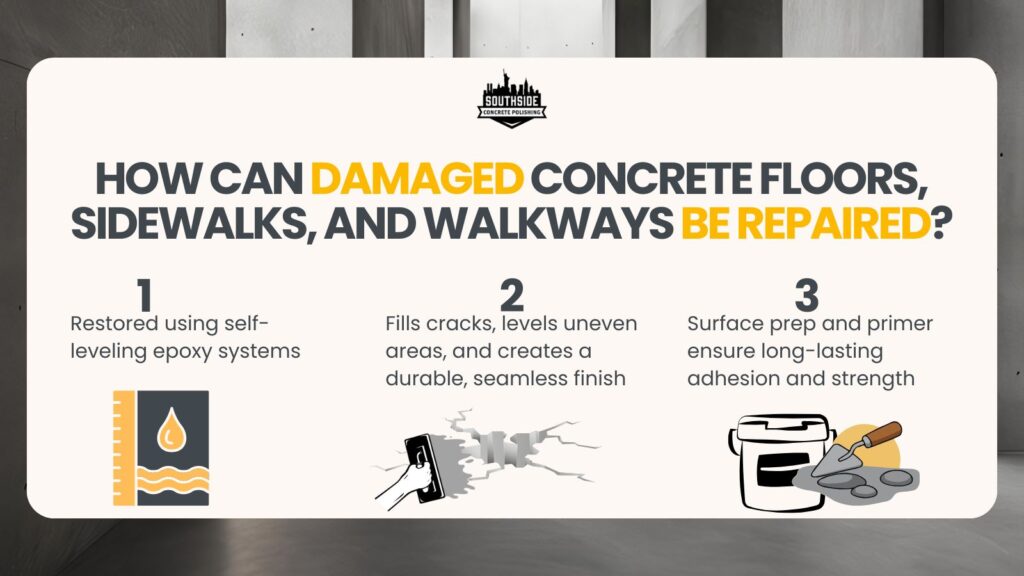
Damaged concrete floors, sidewalks and walkways can be restored effectively using self-leveling epoxy systems. This method resurfaces worn concrete, filling visible cracks and leveling uneven areas to create a seamless, durable finish. The process of concrete floor fixing begins with surface preparation, cleaning, repairing structural defects, and ensuring the substrate is free of contaminants.
Once the concrete floor is ready, a primer is applied to enhance adhesion. The self-leveling epoxy mixture is then poured and spread uniformly using specialized tools to achieve an even coat. After curing, the result is a smooth, resilient surface with improved strength and appearance.
Why Are Self-Leveling Epoxy Floors a Preferred Repair Method?
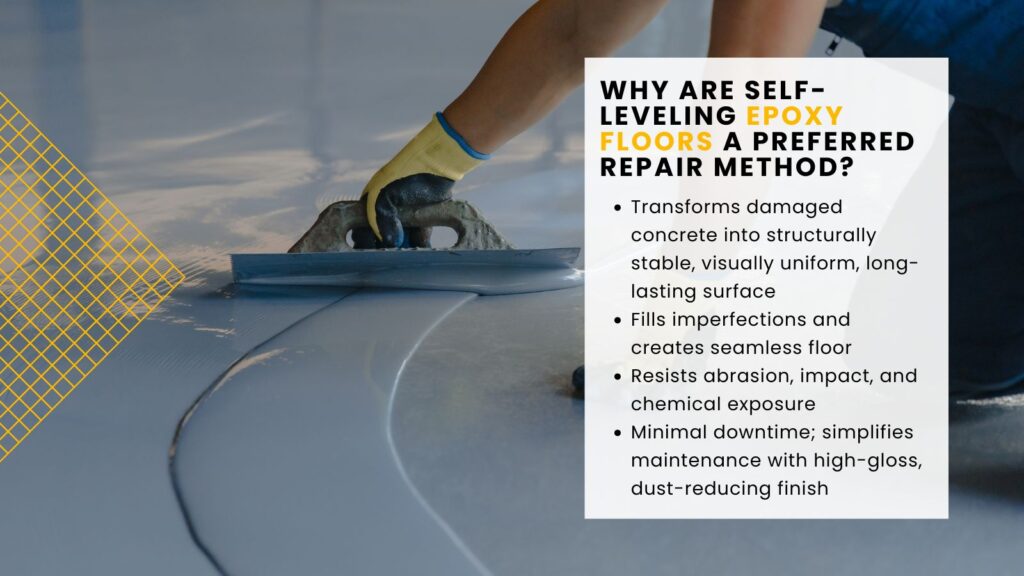
Self-leveling epoxy floors are preferred because they transform damaged concrete into a structurally stable, visually uniform, and long-lasting surface. The material's fluid consistency allows it to spread evenly, filling small imperfections and creating a seamless floor that resists abrasion, impact, and chemical exposure.
Self-leveling epoxy floors require minimal downtime, unlike traditional resurfacing or full replacement. The cured epoxy layer provides a high-gloss finish that reflects light, reduces dust accumulation, and simplifies maintenance, all essential features for both residential and commercial settings.
How Does Self-Leveling Epoxy Improve the Quality of Concrete Surfaces?
Self-leveling epoxy improves the quality of concrete surfaces by providing a protective and aesthetic overlay. The resin penetrates minor cracks and pores, bonding tightly with the substrate to prevent further deterioration. It also seals the surface against moisture intrusion, one of the primary causes of concrete weakening over time.
The resulting layer enhances compressive strength and prevents dusting, contributing to safer and cleaner environments in garages, workshops, or public walkways. Although epoxy does not replace structural repair, it complements foundational reinforcement by extending the lifespan of existing concrete.
Where Should a Concrete Overlay Be Used Instead of Epoxy?
A concrete overlay is used instead of epoxy when the goal is to improve both the appearance and the load-bearing capacity of a surface. While epoxy primarily functions as a leveling and sealing solution, overlays add structural rigidity by bonding a new layer of concrete over the existing slab. This approach is preferred in high-traffic areas where mechanical strength is as important as surface finish.
Typical applications of concrete overlay include:
-
Commercial Car Parks: Concrete overlays are ideal for parking structures exposed to constant vehicle movement and weight. The additional concrete layer strengthens the surface, prevents cracking from tire pressure and temperature changes, and maintains a uniform appearance even under heavy use.
-
Industrial Floors: In manufacturing or production environments, concrete overlays increase the floor's ability to withstand the impact of heavy machinery and constant vibration. The added layer distributes load evenly, minimizing wear and structural fatigue over time.
-
Manufacturing Facilities: Reinforced overlays enhance surface durability in facilities with repetitive mechanical operations or material handling. They prevent erosion caused by continuous equipment movement, reducing maintenance needs and downtime.
-
Warehouses: Overlays in warehouse settings create structurally sound and clearly organized spaces. They incorporate color-coded zones, textured pathways, or embedded navigational markers, improving both workflow efficiency and safety in high-traffic storage environments.
What Are the Main Types of Concrete Overlays?
The main types of concrete overlays include stamped, stained, and sprayed overlays. Concrete overlays are categorized by their composition, installation method, and desired visual or structural outcome.
The main types of concrete overlays are as follows:
-
Stamped Concrete Overlay: Designed to replicate the look of natural materials such as stone, slate, or brick, stamped overlays add decorative texture while reinforcing surface durability. They are commonly used for patios, walkways, and entryways where aesthetics and traction are equally important.
-
Stained Concrete Overlay: This overlay introduces color and depth through pigments or acid-based stains that chemically react with the surface. The result is a unique, permanent color variation that enhances visual appeal in showrooms, lobbies, and interior floors without compromising strength.
-
Sprayed Concrete Overlay: Applied using a spray mechanism, this type provides a thin yet resilient coating ideal for exterior surfaces exposed to moisture or foot traffic. It creates a fine-textured, slip-resistant finish suitable for pool decks, sidewalks, and commercial entrances.
What Properties Make Epoxy Flooring Suitable for Industrial and Residential Use?
The properties that make epoxy flooring suitable for industrial and residential use include its durability, chemical resistance, easy maintenance, and visual clarity. Epoxy flooring forms a seamless, non-porous coating that bonds tightly to concrete, creating a surface capable of withstanding heavy use, chemical exposure, and environmental stress.
The following key properties that make epoxy flooring suitable include:
-
High Durability and Compressive Strength: Epoxy floors endure continuous foot and vehicle traffic, heavy machinery, and impact without chipping or cracking. This structural resilience makes them well-suited for warehouses, workshops, and garages where surfaces face constant mechanical stress.
-
Light-Reflective Finish: The smooth, glossy finish of epoxy enhances ambient light reflection, improving visibility and reducing the need for additional artificial lighting. This property contributes to energy efficiency in both residential and commercial spaces.
-
Low Maintenance Requirements: The non-porous surface resists dust accumulation, oil stains, and chemical spills. Routine cleaning requires minimal effort, maintaining hygiene in settings such as commercial kitchens, healthcare areas, and basements.
-
Slip Resistance: Textured aggregates or anti-slip coatings are incorporated into the epoxy layer to improve traction. This customization enhances safety in high-traffic zones, production areas, or spaces prone to moisture.
What Are the Advantages of Using Polished Concrete Floors?
The advantages of using polished concrete floors include durability, low maintenance, aesthetic versatility, and environmental efficiency. Polished concrete floor is created through a multi-step mechanical grinding process using abrasives ranging from 800 to 3000 grit, producing finishes that vary from satin to mirror-like gloss.
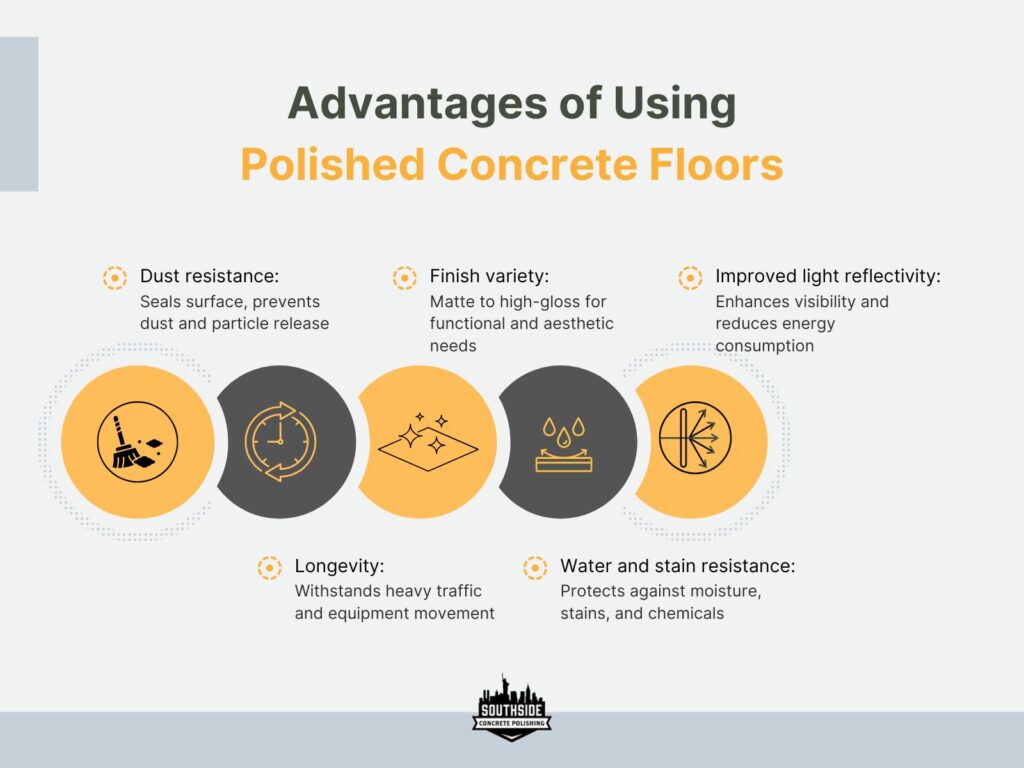
The following are the key advantages of using polished concrete floors are as follows:
-
Dust Resistance: The polishing and densification process seals the surface, preventing dusting and particle release seen in untreated concrete. This creates a cleaner and healthier indoor environment, particularly beneficial in warehouses and public facilities.
-
Longevity: Polished concrete withstands heavy foot traffic, abrasion, and equipment movement without deteriorating. Its durability significantly extends floor lifespan, minimizing repair and replacement costs over time.
-
Finish Variety: A broad spectrum of finish options, from matte to high-gloss, allows customization according to functional and aesthetic needs. Each level of sheen enhances the architectural character of the space while maintaining surface strength.
-
Water and Stain Resistance: Sealers applied during polishing reduce surface porosity, protecting against moisture intrusion, staining, and chemical damage. This property ensures long-term appearance retention even in spill-prone areas.
-
Improved Light Reflectivity: The smooth, reflective finish amplifies natural and artificial light, increasing visibility and reducing energy consumption in interior environments.
How long does self-leveling epoxy take to cure before use?
Self-leveling epoxy typically cures within 24 to 48 hours for light foot traffic, depending on temperature and humidity. Full mechanical and chemical resistance develops after approximately seven days.
Can concrete overlays be applied over old or damaged concrete?
Yes, concrete overlays can be applied over structurally sound but worn or mildly damaged surfaces. Proper surface preparation, cleaning, repairing cracks, and ensuring adequate bonding are essential for durability and adhesion.
What factors determine whether to choose epoxy flooring or a concrete overlay?
The decision of choosing between epoxy flooring or a concrete overlay depends on surface condition, desired function, and load requirements. Epoxy flooring is best for seamless, chemical-resistant finishes, while concrete overlays are chosen when additional structural reinforcement or texture is required.
How much does epoxy flooring cost?
Epoxy flooring typically costs $4 to $12 per square foot, depending on the type of epoxy, surface preparation, and project size. The cost of epoxy flooring that involves high-performance industrial coatings or decorative finishes ranges up to $15--$20 per square foot for specialized applications.