Concrete design choices for commercial construction combine structural integrity, sustainability, and architectural versatility. Modern commercial concrete systems, from decorative overlays to high-performance reinforced slabs, offer durability and aesthetics while meeting performance standards set by the American Concrete Institute (ACI) and ASTM International.
According to Statista's 2025 Global Construction Outlook, commercial concrete demand accounts for over 68% of all poured structural material worldwide, reflecting its dominance in infrastructure, office, retail, and hospitality sectors. The material's compressive strength, ranging between 6,000 and 10,000 psi for industrial-grade mixes (as per ACI 318), ensures structural resilience against variable environmental and load conditions.
With innovations like self-healing concrete, low-carbon cement blends, and polymer-modified coatings, commercial builders now achieve longer service life with reduced maintenance cycles. Concrete's adaptability to industrial flooring, facades, parking decks, and decorative architectural features makes it one of the most cost-effective and sustainable materials in the global construction ecosystem.
What Makes Concrete the Best Choice for Commercial Projects?
Concrete is an optimal material for commercial projects because it unites compressive strength, design versatility, and long-term cost efficiency. Structurally, it supports heavy mechanical loads, resists thermal expansion, and maintains dimensional stability under cyclic stress. According to the World Cement Association (2024), commercial-grade concrete contributes to over 75% of urban infrastructure durability metrics due to its ability to withstand compressive stress and chemical exposure.
Aesthetically, modern concrete systems replicate the appearance of premium architectural materials, such as stone, granite, or terrazzo, through decorative techniques like stamping, staining, polishing, and overlaying. Technologically advanced formulations include fiber reinforcement, silica fume, and polymer additives, which enhance tensile strength and reduce permeability.
Unlike asphalt or resin-based materials, concrete retains its integrity under solar radiation, heavy equipment traffic, and freeze--thaw exposure. High albedo finishes reflect heat, improving building energy efficiency and lowering cooling costs, an essential advantage in global commercial design.
What Are the Most Common Concrete Design Choices for Commercial Construction?
The most common concrete design choices for commercial applications include stamped, stained, colored, and overlay systems. Each system provides distinct performance advantages and visual benefits depending on use case, climate, and design intent.
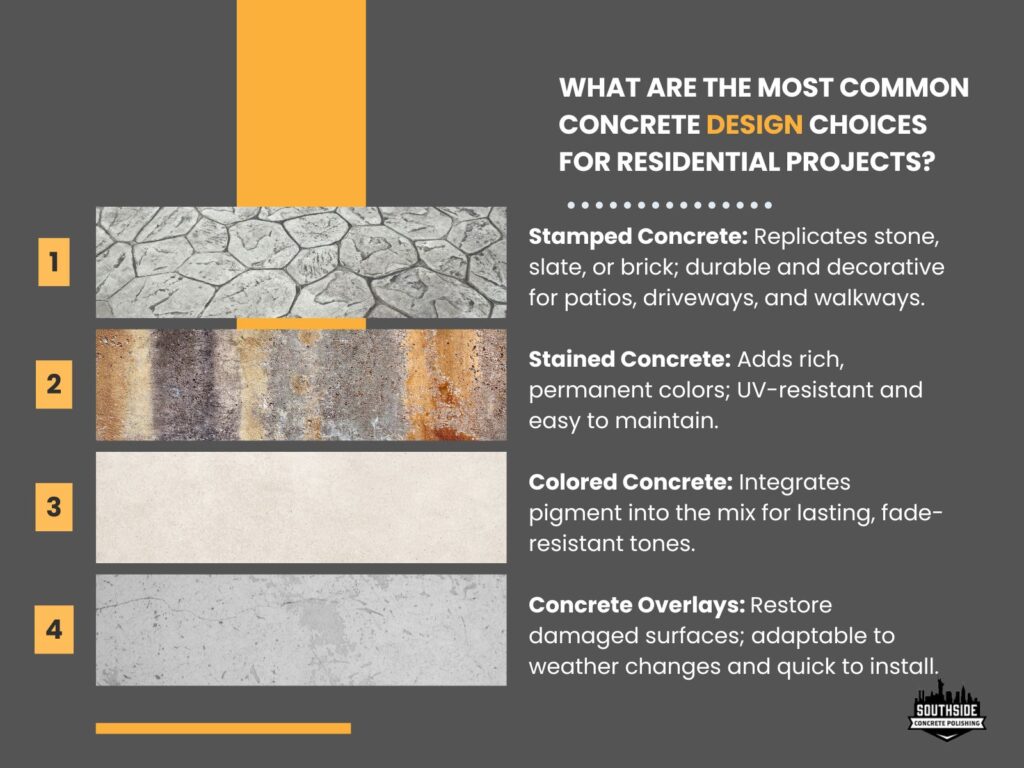
The most common concrete design choices for commercial applications are as follows:
Stamped Concrete
Stamped concrete replicates the textures of high-value architectural materials, such as brick, flagstone, or natural slate, through a pattern-imprinting process. The procedure involves pressing textured mats onto freshly poured concrete, then applying color hardeners and sealers for realism and surface protection.
Stamped concrete delivers the aesthetic value of natural materials without the associated structural or maintenance costs, making it ideal for retail plazas, courtyards, and commercial walkways. According to ACI 544R, properly sealed stamped concrete provides long-term protection against abrasion, deicing salts, and water intrusion. Its non-porous surface resists cracking in both tropical and cold climates, supporting sustainability and reduced lifecycle costs.
Stained Concrete
Stained concrete enhances otherwise plain surfaces with rich, durable pigmentation through acid-based or water-based stains. Acid stains chemically react with calcium hydroxide in the concrete, creating variegated, marble-like tones, while water-based stains provide uniform color control ideal for large-scale interiors.
This method is preferred in hospitality venues, retail centers, and corporate atriums for its elegance and durability. When sealed with UV- and abrasion-resistant coatings compliant with ASTM D3363, stained concrete retains color depth under heavy foot traffic and direct sunlight. Stained concrete also resists microbial growth and surface fading, minimizing cleaning frequency and extending surface lifespan.
Colored Concrete
Colored concrete integrates pigment directly into the concrete mix, ensuring a consistent tone throughout the slab's full depth. This process creates a permanent coloration that won't peel or wear off, unlike topical finishes. The pigment, made of iron oxide or titanium dioxide, chemically bonds within the cement matrix, providing exceptional fade resistance.
Colored concrete is widely used in corporate campuses, transportation hubs, and warehouse floors for both aesthetics and visibility. Even after abrasion or wear, the inherent coloration remains intact, maintaining a professional, uniform appearance. The ACI 303R standard emphasizes pigment dosage precision and mixing control to achieve optimal chromatic stability and strength.
Concrete Overlays
Concrete overlays involve applying a thin, polymer-modified or cementitious layer over existing concrete substrates to renew surface performance and visual appeal. Overlays are suitable for parking structures, airport terminals, and commercial entrances where resurfacing is preferred over full demolition.
Polymer bonding agents ensure chemical and mechanical adhesion, while specialized sealers protect against oils, chemicals, and abrasion. As per ASTM C1583, proper surface preparation and adhesion testing guarantee overlay durability under high traffic. Overlays are customizable with stamping, staining, or micro-topping techniques, allowing for fast installation and minimal business downtime.
How Do Function and Aesthetics Influence Concrete Design Selection?
Function and aesthetics jointly determine the right concrete design for a commercial property. Functional factors such as load capacity, slip resistance, impact tolerance, and chemical resilience guide material selection for industrial or warehouse environments.
Aesthetic factors like color, pattern, texture, and gloss define brand perception and architectural coherence. For instance, polished concrete suits modern corporate interiors, while stamped and stained designs enhance open-air plazas and retail landscapes.
By balancing ACI 302.1R performance recommendations with design intent, contractors ensure that both form and function meet project specifications, optimizing both safety and aesthetics for long-term commercial use.
How Can You Evaluate Which Concrete Finish Is Right for Your Facility?
You can evaluate the best commercial concrete finish by analyzing three main criteria, including performance demands, visual objectives, and lifecycle cost.
You can evaluate the best commercial concrete in the following ways:
-
Performance: Identify load-bearing needs, abrasion resistance, and exposure to chemicals or weather.
-
Aesthetics: Select finishes, pigments, or aggregates that complement architectural themes or corporate branding.
-
Budget and Maintenance: Compare installation costs, cure time, and maintenance frequency over the surface's projected service life.
According to Statista's 2024 Global Construction Materials Report, polished and overlayed concrete systems provide 25--40 years of operational durability with proper sealing and upkeep, offering higher ROI than vinyl, epoxy, or tile in commercial applications.
How Does Cost Influence the Selection of Concrete Design?
Cost directly influences commercial concrete design selection by balancing aesthetic goals, load performance, and lifecycle management.
Decorative systems such as stamped and stained concrete typically range from $80--$200 per square meter, reflecting higher customization and sealing requirements. Colored concrete and overlays, averaging $60--$120 per square meter, provide aesthetic enhancement with lower installation disruption.
Basic industrial flatwork remains the most economical at $40--$70 per square meter, suitable for warehouses or back-end service zones. According to the World Cement Association (2025), commercial facility owners increasingly assess cost based on total lifecycle value, not just installation expense, prioritizing systems that reduce resealing, repair, and downtime over 30+ years.
Why Is Professional Concrete Installation Crucial in Commercial Construction?
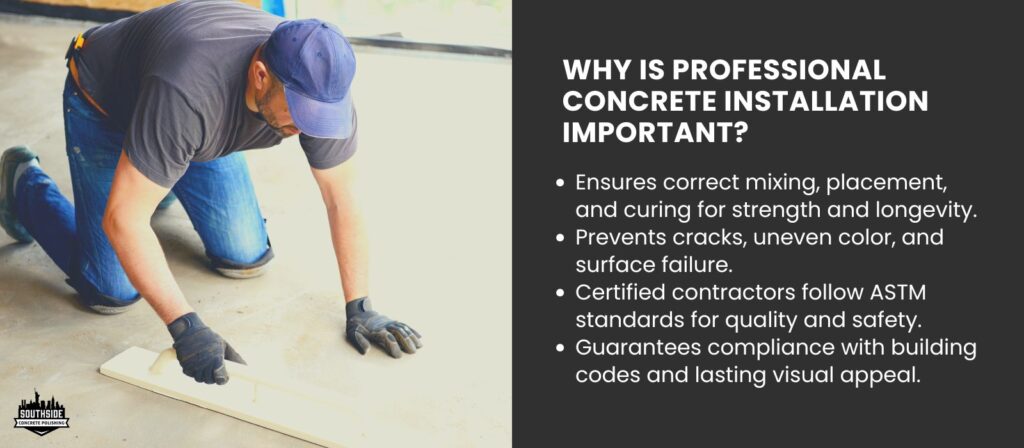
Professional concrete installation is essential because the strength, finish, and lifespan of commercial slabs depend on correct mixing, placement, and curing practices. Improper ratios or inconsistent curing lead to surface scaling, delamination, or uneven color distribution.
Experienced contractors follow ASTM C94 and ACI 308R standards to control water-to-cement ratios, curing environments, and reinforcement placement. They also ensure proper drainage gradients and substrate compaction, key to large-scale industrial flooring.
Professional concrete installation reduces long-term operational costs by minimizing early failures and ensuring compliance with ISO 22965 global standards for ready-mix concrete quality.
What Maintenance Practices Extend the Life of Commercial Concrete Surfaces?
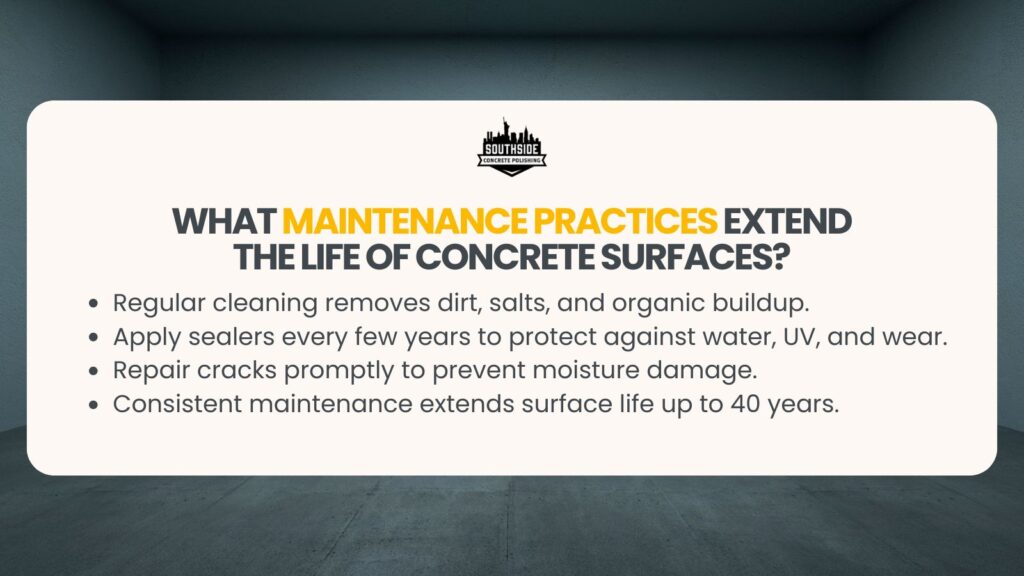
Maintenance practices that extend the lifespan of commercial concrete include routine cleaning, sealing, and periodic inspection for stress cracks or chemical wear.
Scheduled power washing removes debris and deicing salts that accelerate erosion, while penetrating sealers (ASTM C309-compliant) reduce water ingress and chemical absorption. Applying sealers every 2--3 years preserves gloss and structural density.
Timely crack repair prevents moisture-driven spalling, while surface reconditioning via grinding and resealing restores texture and traction. Global research from The Concrete Institute (TCI, 2024) indicates that consistent maintenance extends concrete's service life from 25 to over 50 years, depending on usage intensity and climate exposure.
How Do Decorative Concrete Solutions Add Value to Commercial Properties?
Decorative concrete enhances commercial property value by merging brand aesthetics, sustainability, and performance efficiency. Stamped and stained finishes boost exterior appeal and align with architectural branding, while polished concrete floors improve reflectivity and reduce lighting costs.
According to the Global Construction Value Report (2024), decorative concrete upgrades yield returns between 55% and 70% at resale or facility valuation. Additionally, overlays and resurfacing reduce demolition waste and carbon output, supporting LEED certification goals.
Decorative concrete positions commercial assets as both visually compelling and economically efficient in the long term by combining functional durability with customizable aesthetics.
When to Consider Epoxy Flooring Versus Decorative Concrete in Commercial Projects?
Epoxy flooring is an ideal choice for commercial spaces that require a seamless, chemical-resistant, and highly durable surface. Unlike decorative concrete options such as stamped, stained, or overlay systems, epoxy provides superior protection against abrasion, spills, and heavy machinery traffic, making it particularly suited for warehouses, industrial kitchens, and production facilities. Epoxy flooring emphasizes functionality, low maintenance, and long-term resilience under high-use conditions. For projects where operational efficiency, safety, and easy cleaning are priorities alongside a visually uniform surface, epoxy flooring.